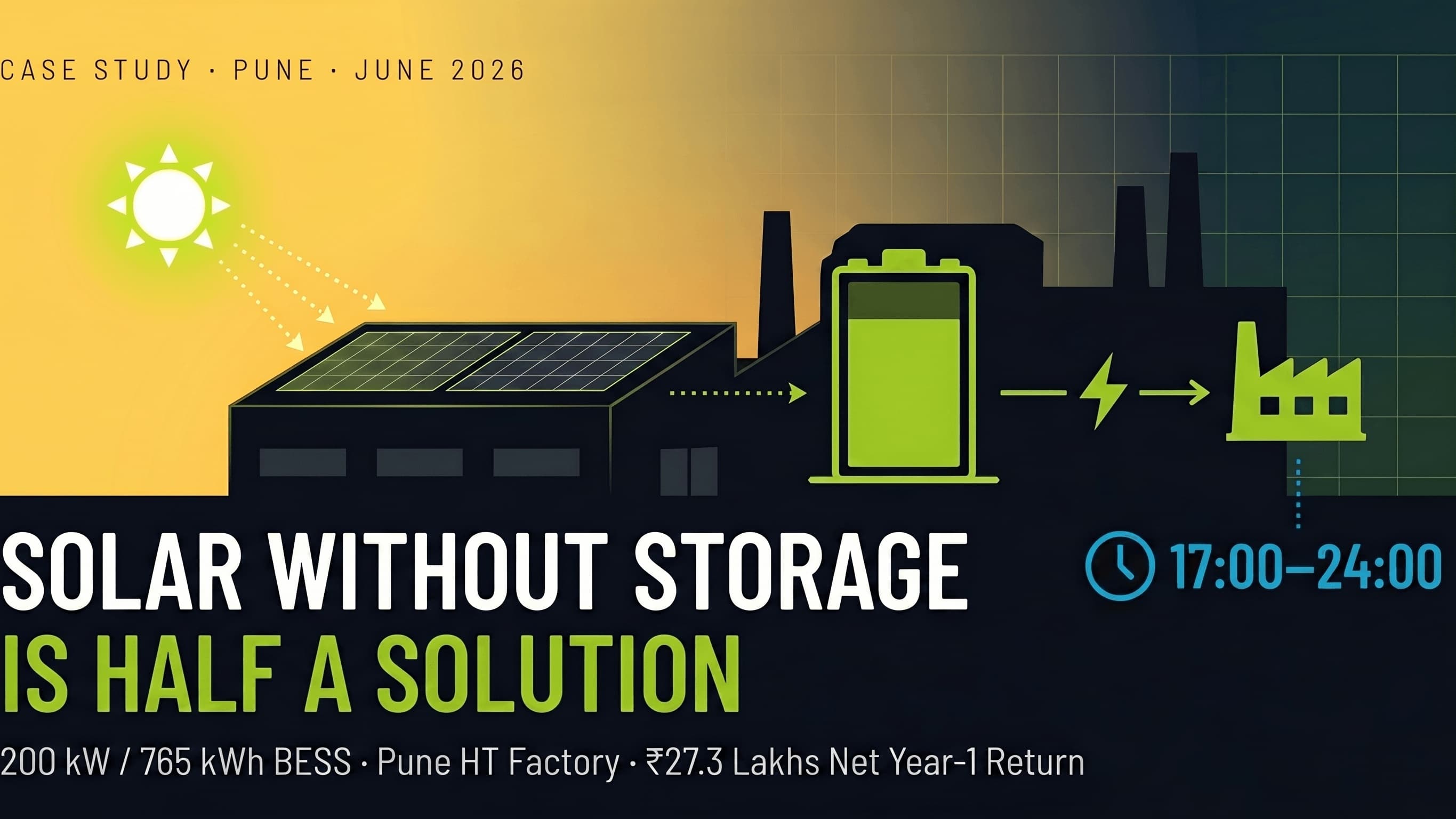
Most HT consumers in Maharashtra who invest in rooftop solar do so expecting a material reduction in their electricity bill. Many get one, but a smaller one than their solar installer projected. The solar system works; the economics underperform.
The reason is usually not module yield, inverter quality, or plant uptime. The problem is structural. Solar generates during the day, while many factories consume hardest in the evening peak when grid power is most expensive.
This case study shows how that mismatch played out at a Pune manufacturing facility, and how a correctly sized BESS converted wasted daytime solar into evening savings, diesel displacement, and an operating lease structure that stayed positive from Year 1.
The Situation: A Factory Generating Solar Energy It Could Not Use
The client operates a factory in Pune on a 22 kV MSEDCL HT connection and installed a 300 kWp rooftop solar system in September 2024. On paper, this should have materially reduced electricity cost. In practice, it exposed a timing mismatch embedded in the site's load profile.
Solar generation occurred in the 09:00–17:00 window. The factory's peak demand sat in the 17:00–24:00 evening window, where the D-zone surcharge applies on top of base energy charges under Maharashtra's Time-of-Day tariff structure. The consequence was severe: surplus solar was exported to the grid at a net credit of ₹2.8/unit, while evening power was purchased back at ₹14.3/unit.
This is not an accounting anomaly. It is a daily value leak.
Every unit exported cheaply and repurchased expensively widened the gap between installed solar capacity and realised economic benefit.
Three Problems. One Root Cause.
The bill-by-bill analysis identified three separate loss mechanisms, all caused by the same issue: the facility had solar generation, but no storage.
1. Solar export at low value
Because daytime load was already covered, 72% of all solar generated — about 2,19,967 kWh/year — was exported rather than self-consumed. That energy left the premises at ₹2.8/unit instead of offsetting high-cost evening consumption.
2. Expensive evening grid dependence
The factory drew between 9,364 and 18,405 kWh/month from the grid in the D-zone evening window. This attracted a ToD surcharge of ₹2.2/unit and cost ₹2.5 Lakhs in surcharges in just nine months — before considering the higher avoided value of self-consumed solar during that same period.
3. Weekly diesel dependence despite having solar
Every Thursday, MSEDCL disconnected the feeder from 09:00 to 17:00 for maintenance, which caused the solar inverter to shut down — it no longer had grid voltage as a reference. The factory then ran on diesel at ₹32.4/kWh, even during solar hours.
Taken together, these three problems represented ₹27.3 Lakhs in annual savings the site could have captured, but was structurally unable to realise without storage.
The Diagnosis: Sizing the Solution to the Actual Problem
PWRNXT sized the system from the Solar Banking Register and the factory's actual load profile rather than from generic duration assumptions. The objective was not merely to install storage, but to install enough storage to capture the value that actually existed on site.
The selected configuration was 200 kW / 765 kWh, delivering 688 kWh of usable storage at 90% Depth of Discharge. That allows full daily surplus capture in 7 of 12 months and partial capture in the five highest-surplus months, resulting in an overall annual capture efficiency of 85.5%.
A smaller 125 kW / 514 kWh system was analysed and rejected because it would have captured only about 66% of average daily surplus — leaving 239 kWh/day uncaptured on average and giving up roughly ₹7.3 Lakhs/year in Year-1 value.
The Technical Solution: What the BESS Actually Does
The proposed system is a 200 kW / 765 kWh LFP Battery Energy Storage System installed Behind-the-Meter at the HT connection point. It performs two distinct operational roles across the week.
On normal grid days, the BESS stores surplus rooftop solar during the day and discharges into the evening load — converting export into self-consumption at full avoided-cost value. On Thursday outages, it acts as an island voltage source so the solar inverter can remain operational during the grid-off window, allowing solar to keep running and preventing diesel dependence during daylight hours.
The 200 kW PCS provides constant discharge current of 290A. This means the system can support the client's 173 kW peak load for up to four hours and serve critical equipment — including the VPI oven, testing, and winding loads — within that operating envelope.
Three Value Streams. One Investment.
The value case is strongest when viewed as three separate streams rather than one blended saving number. Each stream maps to a different operational problem the client already recognises on the ground.
| Value Stream | What It Does | Year-1 Saving |
|---|---|---|
| Stream A — ToD Solar Arbitrage | Stores 689 kWh/day of surplus solar and avoids evening grid purchase at ₹14.3/unit across 278 grid days/year | ₹18.7 Lakhs |
| Stream B — Thursday BESS Discharge | Discharges 606 kWh into evening load after Thursday grid restoration across 52 days/year | ₹4.5 Lakhs |
| Stream C — Diesel Elimination | Allows solar to directly power the factory during Thursday grid-off hours — diesel generator stays off | ₹6.1 Lakhs |
| Gross Annual Value | ₹29.3 Lakhs | |
| Annual O&M | (₹2.0 Lakhs) | |
| Net Year-1 Return | ₹27.3 Lakhs | |
The importance of this structure is strategic. The BESS is not dependent on one narrow savings mechanism. It earns its economics through a stack of operational interventions: tariff arbitrage, outage-linked shifting, and diesel replacement.
The Financing Decision: Choosing the Right OpEx Lease Structure
For this case study, the relevant adoption pathway is not CAPEX. It is operating lease — because the central commercial question is how to adopt BESS without upfront capital while remaining cash-positive from the first year.
PWRNXT can structure the project in two OpEx formats, both of which are positive from Month 1 because the Year-1 monthly saving is ₹2,27,490 in either case. The distinction is not whether the system pays for itself — it does. The distinction is whether the client prefers lower monthly outflow or a shorter lease duration.
OpEx Lease @ 10%
60 Months
OpEx Lease @ 12%
48 Months
A conventional energy capex asks the business to deploy money now in order to save money later. This structure does not. The BESS generates monthly savings first, services its own lease from those savings, and still leaves a surplus from the first billing cycle.
This asset should be framed correctly. It is not financed equipment — it is a value-generating operating asset whose economic output exceeds its monthly carrying cost from Year 1. As D-zone tariffs escalate on the MERC trajectory, the monthly value generated by the system expands while the lease payment remains fixed.
Find out exactly how much your
factory is leaking every month
If your site has rooftop solar and evening peak demand, you likely have a BESS opportunity worth ₹15–30 Lakhs/year. PWRNXT will size it, model the savings, and structure the lease — using your actual bills, not industry averages. No cost, no obligation.
What Changes Strategically Once BESS Is Installed
The most obvious change is solar utilisation. The system shifts an average of 649 kWh/day from export to self-consumption and raises effective solar utilisation from 28% to about 89% of annual generation. That alone changes the economics of the client's existing rooftop solar asset.
The second change is operational resilience. On 52 Thursdays a year, the factory no longer needs to default to diesel during daylight solar hours because the BESS provides the voltage reference needed to keep the solar inverter alive during outage conditions.
The third change is budget quality. BESS converts a variable and escalating evening energy cost into a fixed and widening monthly saving, while reducing the client's exposure to uncertain outcomes around banking value and related external dependencies.
The fourth change is carbon performance. The proposal estimates about 178 tonnes of CO₂ avoided annually — approximately 2,131 tonnes over 12 years — combining D-zone displacement with diesel elimination.
What PWRNXT Warrants — Contractually
A recurring weakness in industrial energy procurement is that commercial promises and technical accountability often sit in separate boxes. This proposal explicitly ties them together through warranty, uptime, and service commitments.
The offered package includes:
- 5-year standard performance warranty on battery modules, PCS, and EMS
- Annual system availability of at least 95%
- Guaranteed round-trip efficiency of at least 85%
- Battery State of Health above 85% at the end of the 4-year lease term
- Quarterly preventive maintenance
- 24/7 remote monitoring with defined on-site emergency response escalation
This matters because the commercial case only holds if the system performs consistently. The difference between supplying a battery and solving an energy problem lies in who holds post-commissioning performance responsibility. In this structure, that responsibility is explicit.
Which Industrial Facilities Should Pay Attention
This case is specific, but the pattern is common across Maharashtra industrial consumers with existing or planned rooftop solar and evening-heavy consumption. A facility should investigate a similar model urgently if most of the following are present:
- The site has an HT MSEDCL connection
- Rooftop solar is already installed or under active planning
- The highest draw occurs in the 17:00–24:00 evening window
- The site experiences periodic outage conditions or relies on diesel backup during grid interruptions
- Daytime solar generation creates regular export rather than direct self-consumption
If at least three of these conditions are present, the facility likely has a meaningful BESS opportunity that should be quantified using actual bills, interval load behaviour, and tariff mapping — not rough assumptions.
Download the Full Case Study
The full proposal includes the executive summary, month-wise surplus capture logic, financial value stream breakdown, lease pathways, warranty commitments, and scope inclusion and exclusion notes that underpin this article.