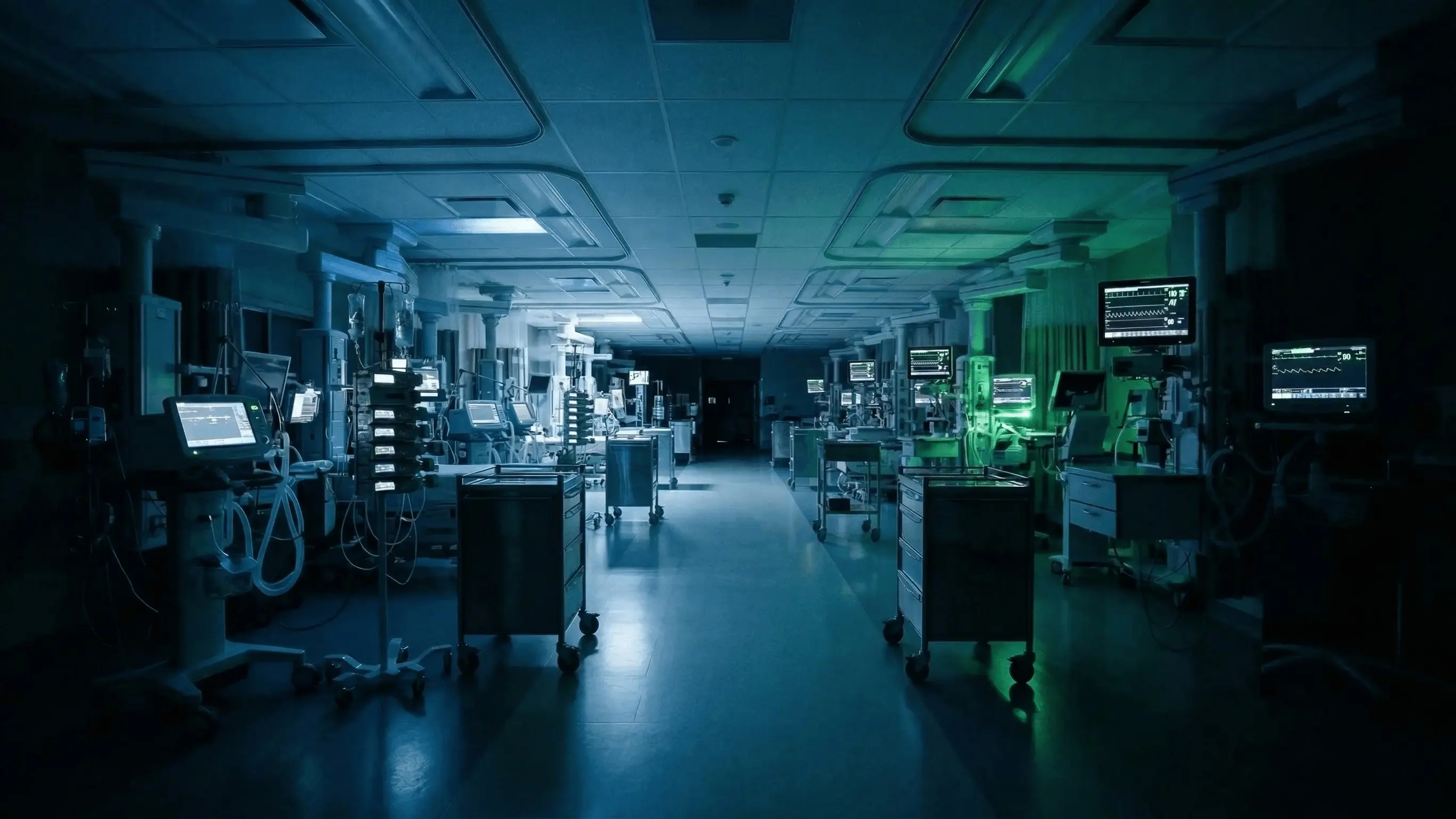
A Power Cut
in an ICU is Not
an Inconvenience.
Unless You Have BESS.
Battery Energy Storage for Hospitals India — Replace Diesel Generators with Sub-10ms BESS. Zero Capex. GRAP Compliant.
Every ventilator, infusion pump and surgical light stays live — the 15–30 second DG startup gap that triggers alarms and interrupts critical procedures is permanently eliminated.
What Hospital Diesel Actually Costs
True all-in cost for a 125 kVA DG running 250 outage hours: ₹17.7 lakh — before the patient-safety liability of a 15–30 second startup gap.
Fuel at ₹34 Per kWh
At ₹95 per litre and a real-world generator efficiency of 2.8 kWh per litre, hospital diesel backup costs ₹34 per kWh delivered — versus ₹10–12/kWh from PWRNXT BESS charged on grid tariffs. A 125 kVA system running 250 outage hours annually burns through ₹10.6 lakh in fuel alone.
Maintenance, Operators & Compliance
Scheduled overhauls, oil changes, spares, and a part-time DG operator add ₹5.6 lakh per year to a 125 kVA hospital installation. NCR hospitals add GRAP-mandated RECD retrofits (₹1.5–2L per set), low-sulphur diesel premiums of ₹5–8 per litre, and CAQM runtime logging — costs that rarely appear in the backup power budget line.
The 15–30 Second Gap
No diesel generator in the world can close this window. In the 15–30 seconds between grid failure and DG reaching operational voltage, ICU monitors reset, ventilators trigger alarms, surgical lights dim, blood bank temperature sensors register anomalies, and imaging systems interrupt calibration sequences. This gap is the single largest patient-safety liability in any hospital backup power design — and it is entirely eliminated by BESS.
Total All-In Diesel Backup Cost — 125 kVA Hospital Critical Load
Fuel + maintenance + operator + GRAP compliance (NCR) + DG depreciation, 250 outage hours/year
BESS Built for ICU, OT and Critical Hospital Power Requirements
Every spec — sub-10ms switching, near-silent operation — addresses a real liability in hospital backup power.
Sub-10ms Switching
PWRNXT BESS transitions from grid to battery in under 10 milliseconds — imperceptible to every ventilator, infusion pump, cardiac monitor, and surgical lighting controller in your facility. The 15–30 second DG startup gap that triggers equipment alarms and interrupts critical procedures is permanently eliminated from the moment the BESS goes live.
Critical Load Coverage
A standard 125 kW / 257 kWh PWRNXT system is sized to cover exactly the infrastructure an 80–100 bed hospital cannot afford to lose: ICUs, operation theatres, CT and MRI imaging suites, pathology laboratories, blood banks, and emergency lighting — for a full 2-hour backup duration on a single charge.
Cheaper from Year One
At ₹16.1 lakh per year all-in versus ₹17.7 lakh for diesel, PWRNXT BESS delivers immediate savings from the first month of operation — not a 5-year payback horizon. Post-lease from Year 6, costs drop to ₹4.9 lakh per year, delivering ₹12.8 lakh in annual savings for every facility in your network.
Near-Silent Operation
Diesel generators operate at over 85 dBA — disruptive in wards, recovery rooms, and consultation areas, and a persistent noise compliance liability in urban hospital premises. PWRNXT BESS operates at approximately 75 dB, comparable to a quiet office. No exhaust fumes near air-handling units, no vibration, no fuel storage risk within the facility perimeter.
Zero Local Emissions
BESS produces zero NOx, zero PM2.5, and zero CO₂ at the facility. This eliminates GRAP compliance exposure entirely for Delhi-NCR hospitals, removes diesel exhaust risk near air intakes and patient areas, and delivers verifiable Scope 1 emission reductions for NABH, JCI, and ESG reporting — from the same system that provides backup power.
Zero Capital Required
PWRNXT owns, installs, and insures the BESS asset. Hospitals pay a fixed monthly operating lease — 100% tax-deductible as OpEx, off the balance sheet. A 125 kW system is available at approximately ₹93,000 per month. No CapEx approval cycle, no depreciation management, no technology risk. Multi-facility chains can deploy in parallel with each site self-funded through diesel displacement.
Diesel Generator vs PWRNXT BESS
Every parameter your clinical, finance, and compliance teams care about — compared directly.
| Parameter | 🔴 Diesel Generator | 🟢 PWRNXT BESS |
|---|---|---|
| Switchover Speed | 15–30 seconds to operational voltage ICU Risk | <10ms — imperceptible to all medical equipment Zero Disruption |
| Effective Energy Cost | ₹34/kWh (₹95/L ÷ 2.8 kWh efficiency) 3× Grid Rate | ₹11.80/kWh (₹10/kWh ÷ 0.85 RTE) Near-Grid Rate |
| Noise Level | >85 dBA — disruptive in wards and recovery rooms Patient Impact | ~75 dB — comparable to a quiet office Ward-Safe |
| Local Emissions | NOx, PM2.5, CO₂, diesel exhaust near air intakes Health Hazard | Zero — no exhaust, no fumes, no PM2.5 GRAP Compliant |
| GRAP Compliance (NCR) | RECD retrofit ₹1.5–2L per set, low-sulphur diesel, CAQM logging Ongoing Cost | Zero compliance exposure — no DG, no reporting obligation Fully Exempt |
| Annual All-In Cost (125 kVA) | ₹17.7L — fuel + maintenance + operator + compliance | ₹16.1L during lease · ₹4.9L post-lease Cheaper Y1 |
| 15-Year Cumulative Cost | ₹265.5L | ₹129.5L ₹136L Saved |
| Upfront Capital | ₹15L+ capex for DG set + installation + fuel storage CapEx Required | Zero — PWRNXT-owned operating lease Pure OpEx |
| NABH / JCI Alignment | No quantified power reliability metrics, DG gap is a known risk point | Sub-10ms transfer directly addresses critical care reliability requirements Accreditation Support |
| Maintenance Burden | AMC, oil changes, load bank testing, operator, fuel procurement logistics | Zero — PWRNXT operates, monitors, and maintains the asset Zero Burden |
The Hospital BESS Cost vs Diesel Numbers That Close the Case
For a Tier-2 multi-specialty hospital with an 80–100 bed critical load (ICU, OTs, imaging, labs) on 250 annual outage hours, PWRNXT BESS is cheaper than diesel from the very first year of operation — not after a multi-year payback period.
The lease model converts a ₹40L asset purchase into ₹93,000 per month in fully deductible OpEx — a number that sits comfortably inside the diesel budget it eliminates. Multi-facility healthcare chains can deploy in parallel across all sites without consolidated capital approval, each deployment self-funded through the diesel savings it generates.
Post-lease from Year 6, energy and AMC costs drop to ₹4.9L per year — delivering ₹12.8L in annual windfall savings per facility for the remaining life of the system.
GRAP is Tightening.
BESS is Your Exit.
Each GRAP revision adds cost and complexity. PWRNXT BESS removes your exposure entirely — no exemptions required.
Turn Compliance Cost into Capital Freed
For a 5-hospital NCR network, eliminating GRAP-related expenditure through BESS deployment frees up a significant budget that goes directly toward clinical or infrastructure investment.
BESS becomes compliance insurance — zero emissions, zero GRAP reporting, zero RECD risk across your entire facility network.
Commission an NCR Healthcare Feasibility StudyBESS Power Reliability as a Clinical and Financial Asset for Hospitals
For boards navigating NABH, ESG scrutiny, and BRSR disclosures, BESS converts backup power into a measurable strategic asset.
NABH / JCI Accreditation
NABH and JCI assessors specifically review critical care power reliability. Sub-10ms transfer time directly addresses the switchover gap risk identified in accreditation frameworks — strengthening your compliance position with a quantified, contractually guaranteed system specification.
Carbon Avoidance — Verified
A 125 kW BESS displacing 80% of diesel backup avoids approximately 24 tonnes of CO₂ per year — equivalent to planting 1,000 trees annually. Over a 15-year system life, that is 360 tonnes of verified Scope 1 emission reductions reportable in BRSR, NABH sustainability audits, and investor ESG disclosures.
Solar Integration Ready
PWRNXT BESS integrates directly with rooftop solar installations — charging from PV generation during the day and dispatching during evening peak hours or outages. For hospitals with existing or planned solar assets, BESS converts backup infrastructure into a net-zero energy platform and can further reduce operational energy costs.
From Feasibility Study to Live BESS
Your existing DG stays live throughout. We handle everything — study, design, installation, commissioning. Zero gap in coverage.
Feasibility Study
PWRNXT engineers conduct a techno-economic feasibility study — baselining your energy bills, DG operating data, outage profile, and critical load to right-size the BESS and quantify the financial case. Delivered within 6 weeks of data receipt.
Lease Structuring
We prepare a fixed-price operating lease proposal — monthly payment, SLA terms, and monitoring scope — with no hidden costs or escalation clauses for the lease duration.
Installation
PWRNXT installs and commissions the BESS in 6–10 weeks alongside your existing DG. Your backup power coverage is uninterrupted throughout, including during commissioning testing.
Live — Monitored 24/7
BESS goes live with 24/7 remote monitoring, automated alerts, and a contractual 98.5% uptime SLA. PWRNXT manages all maintenance. Your clinical team manages patient care.
Speak to our healthcare team about a feasibility study and custom financial model for your facility.
Get a Free ConsultationHospital BESS — Your Questions Answered
See the full cost breakdown: BESS vs Diesel Generator in India — The Real Cost Comparison →
Your Hospital Deserves
Power That Doesn't Blink.
Commission a data-backed BESS feasibility study for your facility — energy baseline, outage profiling, BESS sizing, and a custom 15-year financial model versus your current diesel setup. We revert within 2 business days to scope the engagement.