Battery Storage
Intelligence
Weekly perspectives on BESS technology, policy, costs and the energy transition — written for India's C&I decision-makers.
CEA's New BESS Safety Rules, 2026: What Every C&I Buyer Must Verify
The CEA's 2026 amendment inserts a full BESS-specific safety chapter — two-fault tolerance, mandatory third-party fire audits, fencing and earthing requirements — effective 1 April 2027. Here's the clause-by-clause breakdown of what changes above 650V, what still applies below it, and what to ask your BESS supplier before you sign.
Read the Regulatory Breakdown →Gujarat's Draft DRES & BESS Regulations 2026: The C&I Playbook for Behind-the-Meter Storage
Gujarat's Draft GERC (DRES) and Draft GERC (BESS) Regulations, 2026 permit behind-the-meter BESS but mandate 50% sizing past Contract Demand. The full clause-by-clause breakdown — BTM legality, the 50% Rule with a worked case study, the 1 MW exemption, and the Gross Metering loophole — for C&I developers, EPCs, and prosumers.
Read the Regulatory Breakdown →Maharashtra TOD Tariff & BESS Arbitrage: Time Slots, Surcharges & Savings Under REES Policy 2025-36
The complete Maharashtra TOD time-slot reference — surcharges, rebates, and the ₹6–19/kVAh BESS arbitrage spread it creates for HT & commercial consumers. Section 5.1 waives ₹2.97–3.87/kVAh in charges on the BESS charging leg. Includes demand charge shaving, Group Captive OA, and the 2-hour vs. 4-hour sizing decision.
Read Strategic Framework →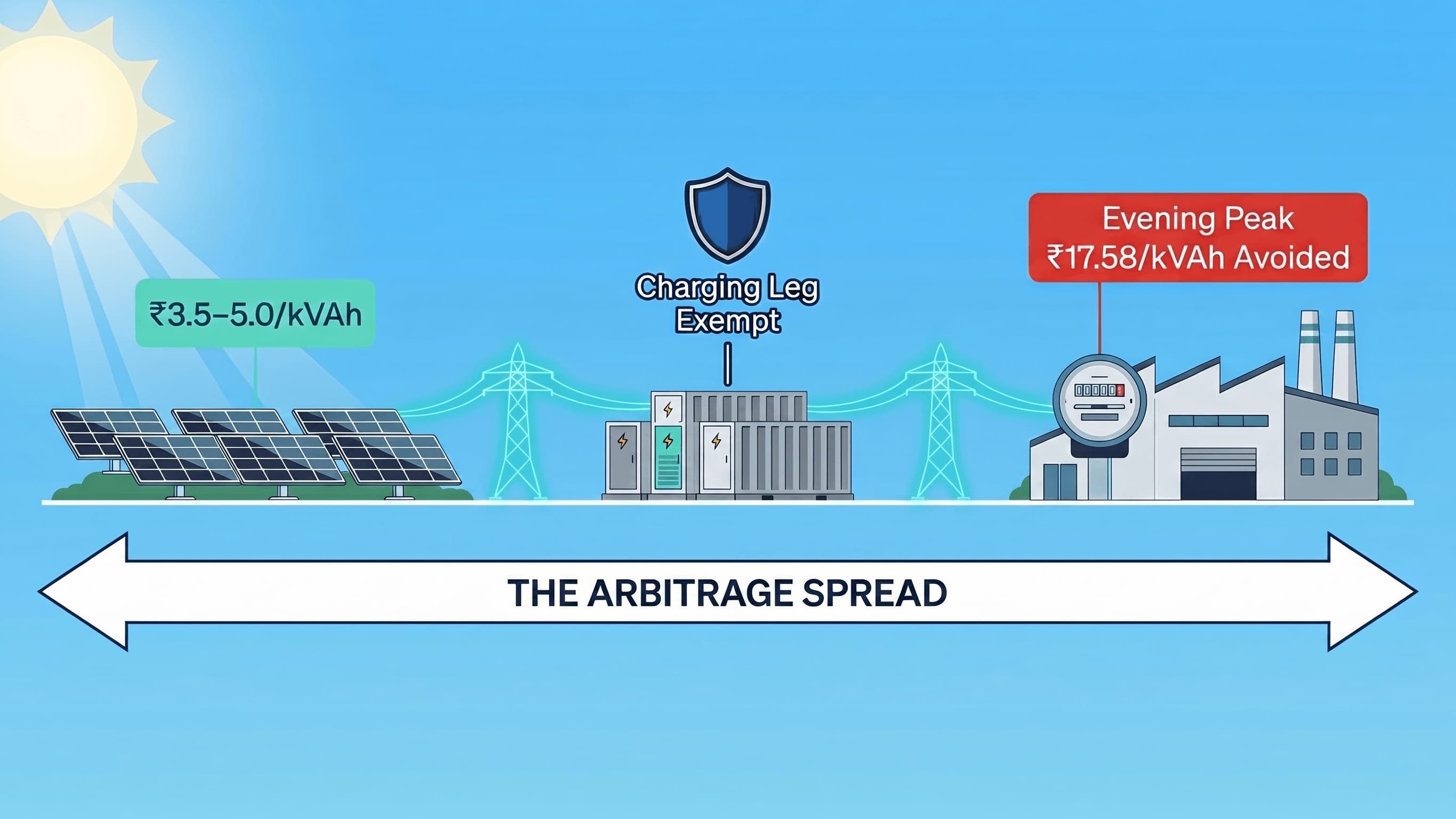
How BESS Rewrites the Tamil Nadu Cost Equation
A real 700 kVA HT-I Erode mill's ToD and Group-Captive bill, worked into a 783 kWh / 375 kW BESS sizing, a ₹10.89/kWh net spread, and a ~4.4-year payback with a 3.3x 15-year return. Part 2 of 2, building directly on Part 1's tariff breakdown below.
Read the BESS Sizing & ROI Model →TNERC Tariff Order 2026: Tamil Nadu C&I Electricity Rates Decoded
A flat 25% surcharge across two peak windows with no midday dip, monthly-only solar banking that forfeits unutilised surplus at 75% value, and a 5% ad valorem tax that rides on top of every ToD adjustment — the complete TNERC HT I–V tariff structure, decoded with a real 700 kVA textile mill bill from Erode.
Read Full Tariff Guide →Battery Storage (BESS) for Rajasthan Solar: The C&I Blueprint
A 100% wheeling waiver at a 30% BESS-to-RE ratio, a 200% captive sizing rule, and a ToD spread solar alone can't reach — the complete Rajasthan BESS blueprint. Part 2 of 2, building directly on Part 1's tariff breakdown below.
Read the BESS Blueprint →Rajasthan Industrial Electricity Tariff: C&I Rates Decoded
A 22% ToD swing, solar that can't reach the evening peak, and banking rules that quietly forfeit value — the complete Rajasthan C&I tariff structure, decoded with worked examples across RERC HT categories, Electricity Duty, FPPAS and open-access wheeling. Part 1 of 2 — continues in the BESS blueprint above.
Read Full Tariff Guide →Solar Without Storage is Half a Solution — A 200 kW / 765 kWh BESS Case Study from Pune
A Pune factory was exporting 72% of its rooftop solar at ₹2.8/unit and buying power back in the evening at ₹14.3/unit. A correctly sized 200 kW / 765 kWh BESS solved the timing mismatch — delivering ₹27.3 Lakhs net Year-1 return, eliminating Thursday diesel dependence, and staying cash-positive from Month 1 under an OpEx lease.
Read Case Study →Grid is No Longer a Free Battery — Maharashtra's Energy Rules Have Changed
MERC's MYT Order 75 of 2025 has permanently closed solar banking arbitrage, activated Grid Support Charges at ₹1.40/unit, and redesigned Time-of-Day tariffs for every C&I consumer in Maharashtra. Here is the complete strategic analysis — including the full 5-year HT tariff table through FY 2030.
Read Regulatory Insight No. 01 →BESS vs Diesel Generator in India: The Real Cost Comparison CFOs Need to See
Most facilities calculate diesel costs at fuel price only. Add thermal losses, maintenance, operator cost and the 10–30 second production gap — and the true cost of DG backup is 3–4× higher than the fuel bill suggests. Here is the full P&L comparison.
Read article →