The Rajasthan industrial electricity tariff is a state-level structure set by the Rajasthan Electricity Regulatory Commission (RERC) and applied uniformly across the state's three DISCOMs — JVVNL, AVVNL, and JdVVNL. This article sets out the current structure, verified against RERC's tariff order effective 1 October 2025.
Three Common Cost Profiles
How Rajasthan C&I Consumers Actually Source Power
Three buyer profiles come up repeatedly among Rajasthan C&I consumers modelling their power costs. Each faces a distinct cost or constraint, addressed with figures in Part 2 of this series.
| Profile | Sourcing Structure | Cost / Constraint |
|---|---|---|
| Captive auto-components manufacturer | Sourcing solar through open access | Pays wheeling charges on every unit delivered over the grid — but is exempt from Cross-Subsidy Surcharge and Additional Surcharge, since these apply only to third-party (merchant) open access sales. Gets no banking facility on any surplus. |
| Textile manufacturer | Rooftop solar under net metering | Avoids wheeling charges entirely — but every unit drawn from the grid during the evening peak window is still billed at the full ToD-adjusted rate, regardless of how much solar it generated earlier that day. |
| Captive solar generator | Sized close to contract demand | Banks surplus during strong-generation months, but only up to a capped, tiered allowance. Generation above that ceiling is not banked by default. |
The remainder of this article works through two numeric examples, scaled to reflect the size of facility most PWRNXT clients actually operate — a 4,000 kVA medium industrial (MP/HT-3) consumer and a 1,000 kVA commercial (NDS/HT-2) consumer. These are illustrative figures, separate from the three profiles above, which describe common sourcing structures rather than specific tariff categories.
RERC HT Tariff Categories Explained
Fixed Charge, Energy Charge, and Where Your Facility Sits
Under RERC's approved tariff schedule, most Rajasthan C&I connections above roughly 25 HP or 125 kVA sit on one of four High Tension (HT) tariff schedules. Each carries its own Fixed Charge (billed per kVA of billing demand — the higher of actual maximum demand or 75% of contract demand) and Energy Charge (billed per unit consumed).
| Category | Applies To | Fixed Charge | Energy Charge |
|---|---|---|---|
| NDS/HT-2 (Commercial) | Shops, offices, hotels, commercial establishments | ₹320/kVA/month | ₹8.50/unit |
| MP/HT-3 (Medium Industrial) | 25–150 HP or up to 125 kVA contract/billing demand | ₹275/kVA/month | ₹6.50/unit (₹6.30 floor after rebates) |
| ML/HT-4 (Mixed Load) | Institutional and mixed-load HT connections | ₹300/kVA/month | ₹7.50/unit |
| LP/HT-5 (Large Industrial) | Above 150 HP or 125 kVA | ₹380/kVA/month | ₹6.50/unit at 11kV, with voltage rebates of 3–5% at 33/132/220kV |
ℹ Source: Rajasthan's state-level tariff order, effective 1 October 2025 (RERC Petition Nos. 2303–2305/2025), as published in JdVVNL's implementation circular.
Selecting the correct category matters. Mixing up MP/HT-3 and LP/HT-5 for a mid-sized factory that has grown past the 125 kVA threshold, or applying NDS/HT-2 commercial rates to a mixed-use facility that should sit on ML/HT-4, are frequent errors. The category determines the fixed charge, the energy charge, and every calculation that follows.
Illustrative Example: A 4,000 kVA Medium Industrial (MP/HT-3) Consumer
Illustrative figures only — a hypothetical consumption profile used to walk through the mechanics, not a real PWRNXT client.
| Line Item | Calculation | Amount |
|---|---|---|
| Fixed Charge | 4,000 kVA × ₹275/kVA | ₹11,00,000 |
| Energy Charge (flat) | 500,000 units × ₹6.50/unit | ₹32,50,000 |
| Subtotal (base, pre-ToD) | ₹43,50,000 |
Illustrative Example: A 1,000 kVA Commercial (NDS/HT-2) Consumer
Illustrative figures only.
| Line Item | Calculation | Amount |
|---|---|---|
| Fixed Charge | 1,000 kVA × ₹320/kVA | ₹3,20,000 |
| Energy Charge (flat) | 150,000 units × ₹8.50/unit | ₹12,75,000 |
| Subtotal (base, pre-ToD) | ₹15,95,000 |
Both examples continue through the following sections, with each section adding the next layer of cost.
Time of Day (ToD) Tariff for Rajasthan
A 22% Swing That Has Nothing to Do With Negotiation
Under RERC tariff orders dating to 2019-20, Rajasthan became an early adopter of Time of Day tariffs — well ahead of the central government's 2023 rules pushing ToD adoption nationwide for consumers with connected load above 10 kW. Under Rajasthan's state-level tariff order, ToD applies uniformly across every HT and qualifying LT commercial/industrial category as a percentage adjustment applied to the Energy Charge. The Fixed Charge is unaffected, and the adjustment is automatic rather than elective.
| Time Block | Hours | Adjustment |
|---|---|---|
| Off-peak | 12:00 pm – 4:00 pm | 10% rebate |
| Morning peak | 6:00 am – 8:00 am | 5% surcharge |
| Evening peak | 6:00 pm – 10:00 pm | 10% surcharge |
| Normal | Remaining hours | No adjustment |
ℹ Source: Rajasthan's state-level tariff order, effective 1 October 2025.
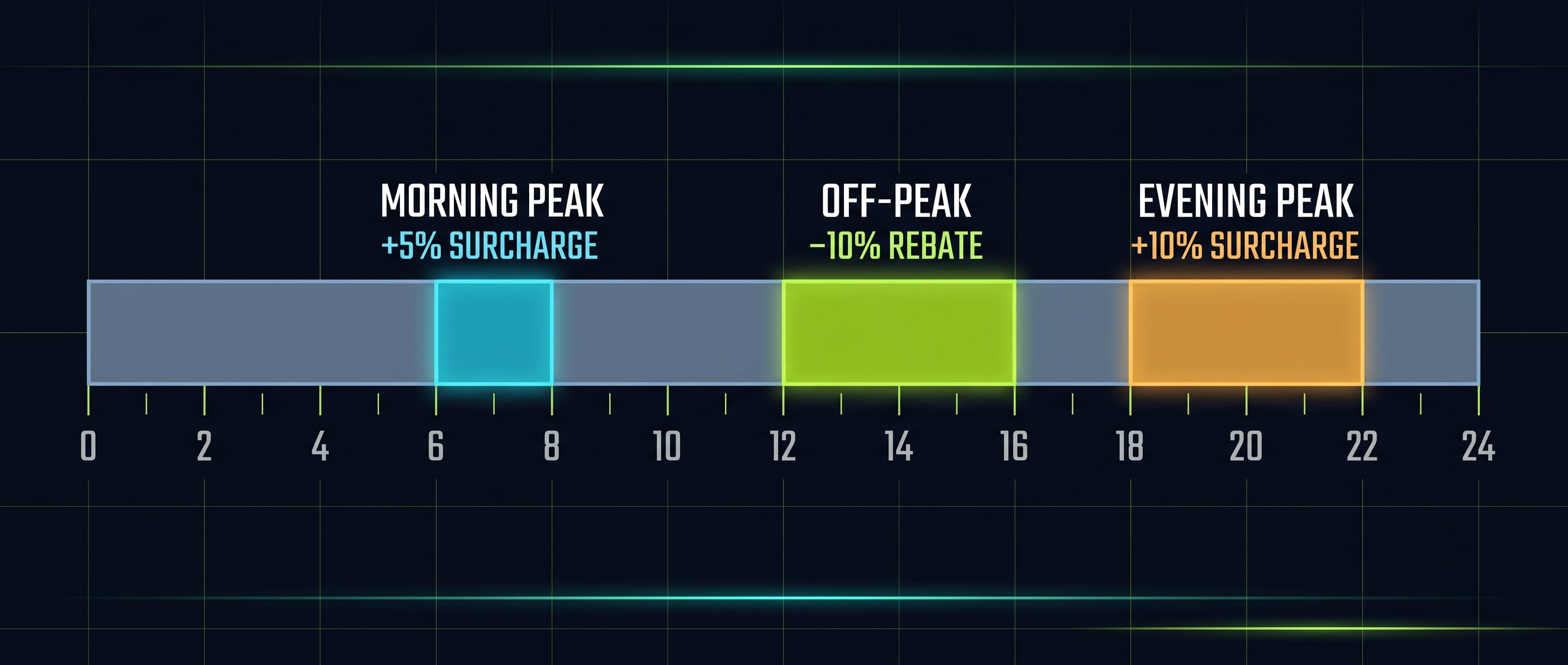
The net effect of ToD on any given consumer depends entirely on their load curve. A single-shift daytime operation captures the off-peak rebate almost by accident. A facility running an evening shift — or a commercial property with evening footfall, like a hotel or retail complex — carries a meaningfully higher effective rate, because its heaviest consumption lands squarely in the 10% surcharge window. The more consequential number, though, isn't the blended bill impact — it's the spread between a facility's cheapest and most expensive hour: for MP/HT-3, that's ₹5.85/unit off-peak against ₹7.15/unit at evening peak, a 22% difference that has nothing to do with efficiency or negotiation, only when power is drawn.
Continuing the Examples: Applying ToD
MP/HT-3, 4,000 kVA, illustrative monthly load split:
| Time Block | Units | Rate | Cost |
|---|---|---|---|
| Off-peak | 80,000 | ₹5.85 | ₹4,68,000 |
| Morning peak | 40,000 | ₹6.825 | ₹2,73,000 |
| Evening peak | 140,000 | ₹7.15 | ₹10,01,000 |
| Normal | 240,000 | ₹6.50 | ₹15,60,000 |
| Total energy charge with ToD | 500,000 | ₹33,02,000 |
Against a flat ₹32,50,000 (no ToD), this evening-heavy load profile costs ₹52,000 more under ToD — a 1.6% increase on the energy charge alone. That's a modest blended figure precisely because the off-peak rebate is still doing real work; a facility that captured none of the off-peak window and ran entirely on evening-peak power would see closer to the full 10% surcharge applied across the board.
NDS/HT-2, 1,000 kVA, illustrative monthly load split:
| Time Block | Units | Rate | Cost |
|---|---|---|---|
| Off-peak | 30,000 | ₹7.65 | ₹2,29,500 |
| Morning peak | 10,000 | ₹8.925 | ₹89,250 |
| Evening peak | 50,000 | ₹9.35 | ₹4,67,500 |
| Normal | 60,000 | ₹8.50 | ₹5,10,000 |
| Total energy charge with ToD | 150,000 | ₹12,96,250 |
Against a flat ₹12,75,000, ToD costs this commercial consumer ₹21,250 more — a 1.7% increase — again driven by evening-heavy demand, typical of hospitality and retail loads.
BESS + Solar on a zero-capex lease shifts your cheapest off-peak and solar-hour units into the evening-peak window — the one block ToD makes most expensive and rooftop solar alone can never touch.
Free analysis · No obligation
Reply within 4 business hours
Electricity Duty Rate and Surcharges
What Sits on Top of the Fixed and Energy Charge
Beyond the Fixed and Energy Charges, Rajasthan's C&I bills carry several statutory and regulatory add-ons.
Under the Rajasthan Electricity (Duty) Act, 1962, Electricity Duty is levied as a flat per-unit charge — not a percentage, despite what some third-party bill calculators suggest. The applicable rates:
| Category | Rate |
|---|---|
| Commercial, domestic, and general industrial | 40 paise/unit |
| Industrial — induction furnace using mild steel scrap, or mild steel re-rolling mills | 52 paise/unit |
ℹ Source: Rate of Electricity Duty notification under the Rajasthan Electricity (Duty) Act, 1962, as published by Rajasthan's Bureau of Investment Promotion (RajNivesh). If your DISCOM statement shows duty as a percentage rather than a flat per-unit figure, confirm the applicable line item directly with your DISCOM — flat, per-unit duty is the rate we've been able to verify against a primary government source.
FPPAS is genuinely variable month to month — but it isn't stacked on top of the Regulatory Surcharge as a second, unrelated cost. Under Clause 32 of the tariff order, the two are designed to net to a combined ceiling of approximately ₹1.00/unit for non-domestic consumers. The order gives its own worked examples: if FPPAS in a given month is ₹0.20/unit, the Regulatory Surcharge for that month is set at ₹0.80/unit; if FPPAS is ₹0.40/unit, the Regulatory Surcharge is ₹0.60/unit. Either way, the combined total holds at ₹1.00/unit. For modeling purposes, ₹1.00/unit combined is a reasonable illustrative planning figure — considerably more useful than treating FPPAS as an open-ended unknown.
| Charge | Illustrative Rate | Basis |
|---|---|---|
| FPPAS + Regulatory Surcharge (combined) | ≈ ₹1.00/unit (non-domestic) | Net to a combined ceiling under Clause 32; FPPAS itself is billed with a one-quarter lag and trued up annually |
| Special FSA | 7.01 paise/unit (flat) | Charged in addition to the combined ₹1.00/unit above |
ℹ Source: Rajasthan's state-level tariff order, effective 1 October 2025, Clause 32.
For open-access consumers specifically, Wheeling Charges apply — and, for third-party (merchant) open access only, Cross-Subsidy Surcharge and an Additional Surcharge apply on top of all of the above. Covered in full in the next section, since these vary by ownership structure, not just by sourcing method.
Continuing the Examples: The Fully Loaded Bill
MP/HT-3, 4,000 kVA:
| Line Item | Amount |
|---|---|
| Fixed + Energy (with ToD) | ₹44,02,000 |
| Electricity Duty (500,000 units × ₹0.40) | ₹2,00,000 |
| FPPAS + Regulatory Surcharge (500,000 units × ≈₹1.00, illustrative) | ₹5,00,000 |
| Special FSA (500,000 units × ₹0.0701) | ₹35,050 |
| Fully loaded running total | ₹51,37,050 |
NDS/HT-2, 1,000 kVA:
| Line Item | Amount |
|---|---|
| Fixed + Energy (with ToD) | ₹16,16,250 |
| Electricity Duty (150,000 units × ₹0.40) | ₹60,000 |
| FPPAS + Regulatory Surcharge (150,000 units × ≈₹1.00, illustrative) | ₹1,50,000 |
| Special FSA (150,000 units × ₹0.0701) | ₹10,515 |
| Fully loaded running total | ₹18,36,765 |
Solar Banking Rules & Wheeling Charges
What Happens to Surplus Depends on How Solar Was Sourced
Banking rules in Rajasthan are not uniform. Under RERC's Green Energy Open Access Regulations, 2025 and Third Amendment to the Grid Interactive DRE Regulations, what happens to surplus solar generation depends on how that solar was sourced.
| Source Type | Banking Allowed? | Ceiling & Basis | Charge |
|---|---|---|---|
| Open Access (third-party sale) | No | Not applicable | — |
| Captive, ≤100% of contract demand | Yes | Higher of 25% of energy injected that month, or 30% of that month's DISCOM consumption; settled annually | 8% (in kind) |
| Captive, 100–200% of contract demand | Yes, tighter | 30% of that billing cycle's consumption only — no annual carry-forward | 8% (in kind) |
| Group Captive | Same as Captive | Inherits the rule for whichever CD tier applies | Same as Captive |
| Rooftop / Net Metering | Net-metering settlement, not a capped "banking" allowance | No fixed ceiling; nets each billing period | None, see below |
ℹ Source: RERC Green Energy Open Access Regulations, 2025; RERC Third Amendment to the Grid Interactive DRE Regulations, 2025.
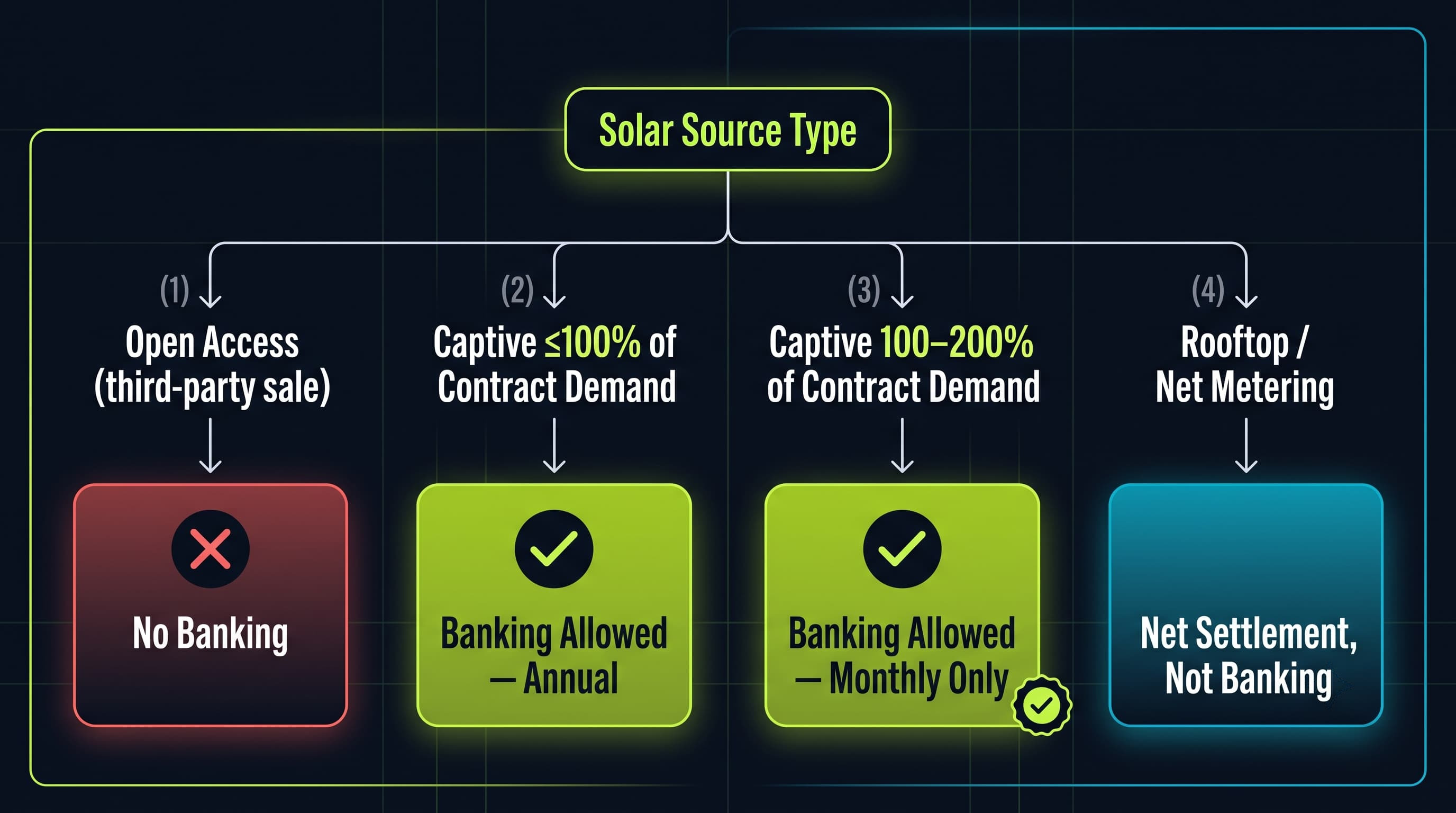
Net Metering Settlement Order: Lowest Tariff Slot First
For Time-of-Day consumers under Group or Virtual Net Metering, RERC's Third Amendment specifies that surplus is settled starting from the lowest tariff slot first, working upward. In practice, that means solar surplus — generated mostly during off-peak and normal hours — nets against a consumer's cheapest consumption first, not their most expensive evening-peak consumption, even when the evening peak is where a facility draws the most power.
Continuing the Examples: Banking and the Opportunity Cost of Solar Surplus
MP/HT-3, captive rooftop solar — illustrative strong-generation month, separate from the load-profile month above:
Say this factory installs a 3,000 kW captive rooftop system. In a strong-generation month, it self-consumes 1,20,000 units directly and injects 1,20,000 units of surplus, against DISCOM (grid) consumption of 3,00,000 units that month.
| Step | Calculation | Result |
|---|---|---|
| Banking ceiling | Higher of (25% × 1,20,000 = 30,000) or (30% × 3,00,000 = 90,000) | 90,000 units |
| Units banked | Capped at ceiling | 90,000 units |
| Units not banked (exceed ceiling) | 1,20,000 − 90,000 | 30,000 units |
| Banking charge (8% of banked units) | 8% × 90,000 | 7,200 units |
| Net units available for later withdrawal | 90,000 − 7,200 | 82,800 units |
| Value lost to the banking charge alone | 7,200 × ₹6.50/unit | ₹46,800 |
The 7,200 units lost to the banking charge are a guaranteed, calculable cost of using the banking facility at all. The 30,000 units that exceed the ceiling are the more consequential number, and their value depends entirely on what happens to them next:
| Disposition of the 30,000 unbanked units | Illustrative Value | Notes |
|---|---|---|
| Unrecovered / curtailed | ₹0 | No export or storage arrangement in place |
| Exported at RERC's generic solar procurement rate | ≈ ₹60,000–₹75,000 (₹2.00–2.50/unit) | A fraction of retail value; actual rate should be confirmed against the current DISCOM PPA/order |
| Stored and discharged against evening-peak consumption | ₹2,14,500 (₹7.15/unit) | Roughly 3x the export value and infinitely better than curtailment — this is the arbitrage Part 2 quantifies |
That final row is the throughline into Part 2: the same 30,000 units that fall outside the banking ceiling are worth up to three times more captured through storage than sold at the generic solar rate, simply because storage lets them offset the evening-peak block instead of the grid's own (much lower) power-purchase cost.
NDS/HT-2, rooftop solar under Group Net Metering — illustrative month:
Say this commercial complex installs an 800 kW rooftop system under GNM. It self-consumes 60,000 units directly and exports 40,000 units of surplus, generated during the day.
| Step | Calculation | Result |
|---|---|---|
| Surplus nets against off-peak first | 30,000 units × ₹7.65 | ₹2,29,500 |
| Remaining surplus nets against Normal hours next | 10,000 units × ₹8.50 | ₹85,000 |
| Total value of surplus, as actually settled | ₹3,14,500 | |
| What the same 40,000 units would be worth offsetting evening-peak consumption instead | 40,000 units × ₹9.35 | ₹3,74,000 |
| Opportunity cost of the settlement order | ₹3,74,000 − ₹3,14,500 | ₹59,500 |
This ₹59,500 is not a fee or a charge — it is forfeited value, a function of when solar generates and how surplus is applied under standard net-metering settlement rules. It does not appear as a line item on any bill.
Open Access: Wheeling and Cross-Subsidy Charges
This is where most coverage collapses a real distinction into a single "open access" bucket. Wheeling Charge applies regardless of ownership structure. Cross-Subsidy Surcharge and Additional Surcharge apply only to third-party (merchant) open access — captive and group captive structures, which meet the ownership and self-consumption tests under the Electricity Rules, 2005, are exempt from both.
| Charge | Applies To | Rate |
|---|---|---|
| Wheeling Charge | All open access — third-party, captive, and group captive alike | ₹0.62/kWh at 11kV, ₹0.12/kWh at 33kV, ₹0.01/kWh at 132kV+ |
| Cross-Subsidy Surcharge (CSS) | Third-party (merchant) open access only | ₹1.58/kWh, uniform across voltage levels |
| Additional Surcharge | Third-party (merchant) open access only | ₹0.72/kWh |
ℹ Source: reporting on RERC's approved FY2026 retail tariff order (Petition Nos. 2303–2305/2025); Additional Surcharge exemption for captive generation per GEOA Regulation 11.5.
A correctly sized BESS captures the units your banking ceiling leaves behind and discharges them against Rajasthan's most expensive hour — on a zero-capex operating lease, no changes to your solar sourcing structure required.
Free · 5 working days · No capex commitment
Putting It All Together
The Full Bill and Your Solar Capture Options
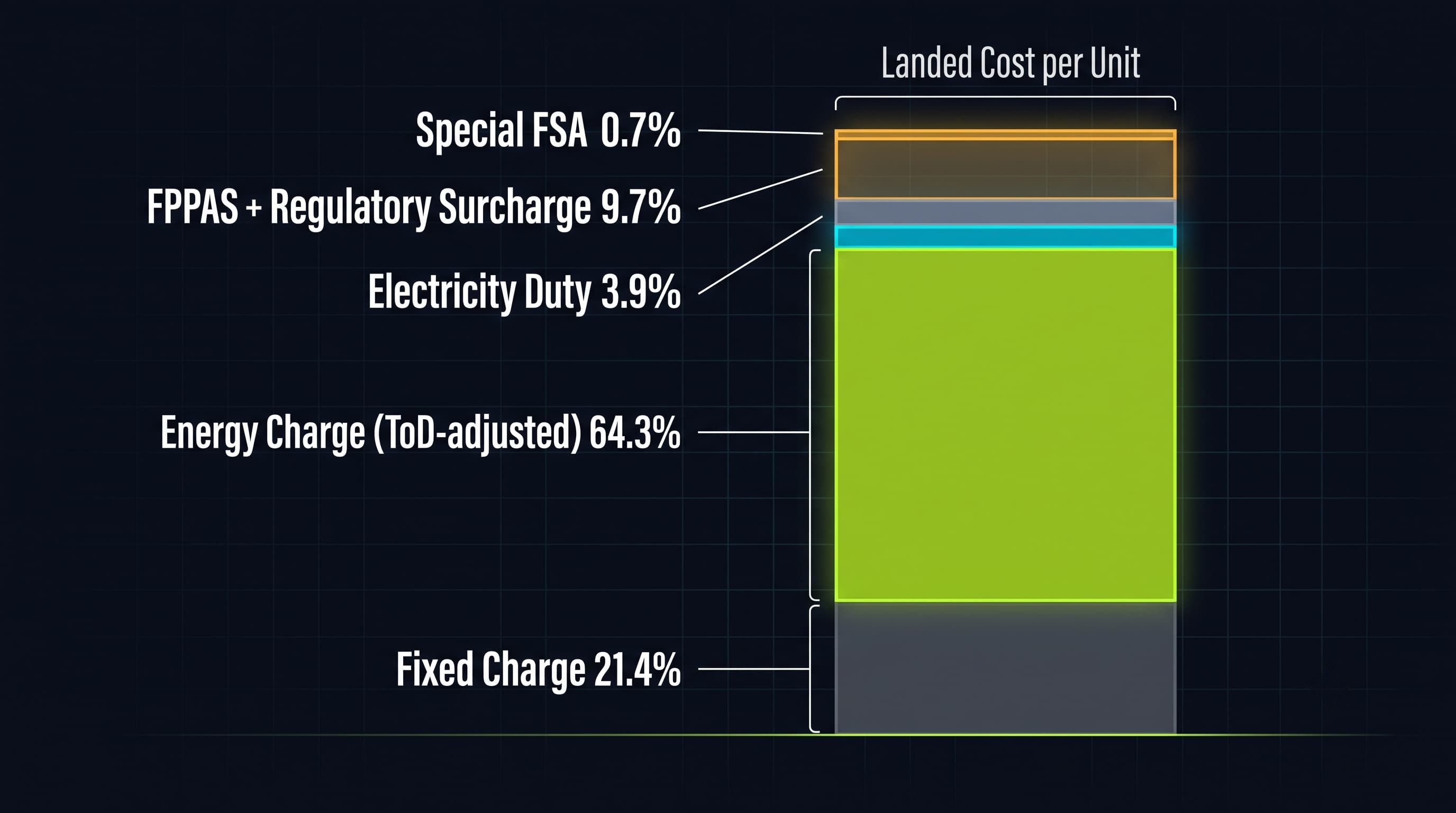
Pulling every line item together, here's what each charge actually contributes to the two worked examples' fully loaded totals:
| Charge | MP/HT-3, 4,000 kVA (₹) | % of Bill | NDS/HT-2, 1,000 kVA (₹) | % of Bill |
|---|---|---|---|---|
| Fixed Charge | 11,00,000 | 21.4% | 3,20,000 | 17.4% |
| Energy Charge (ToD-adjusted) | 33,02,000 | 64.3% | 12,96,250 | 70.6% |
| Electricity Duty | 2,00,000 | 3.9% | 60,000 | 3.3% |
| FPPAS + Regulatory Surcharge | 5,00,000 | 9.7% | 1,50,000 | 8.2% |
| Special FSA | 35,050 | 0.7% | 10,515 | 0.6% |
| Total | 51,37,050 | 100% | 18,36,765 | 100% |
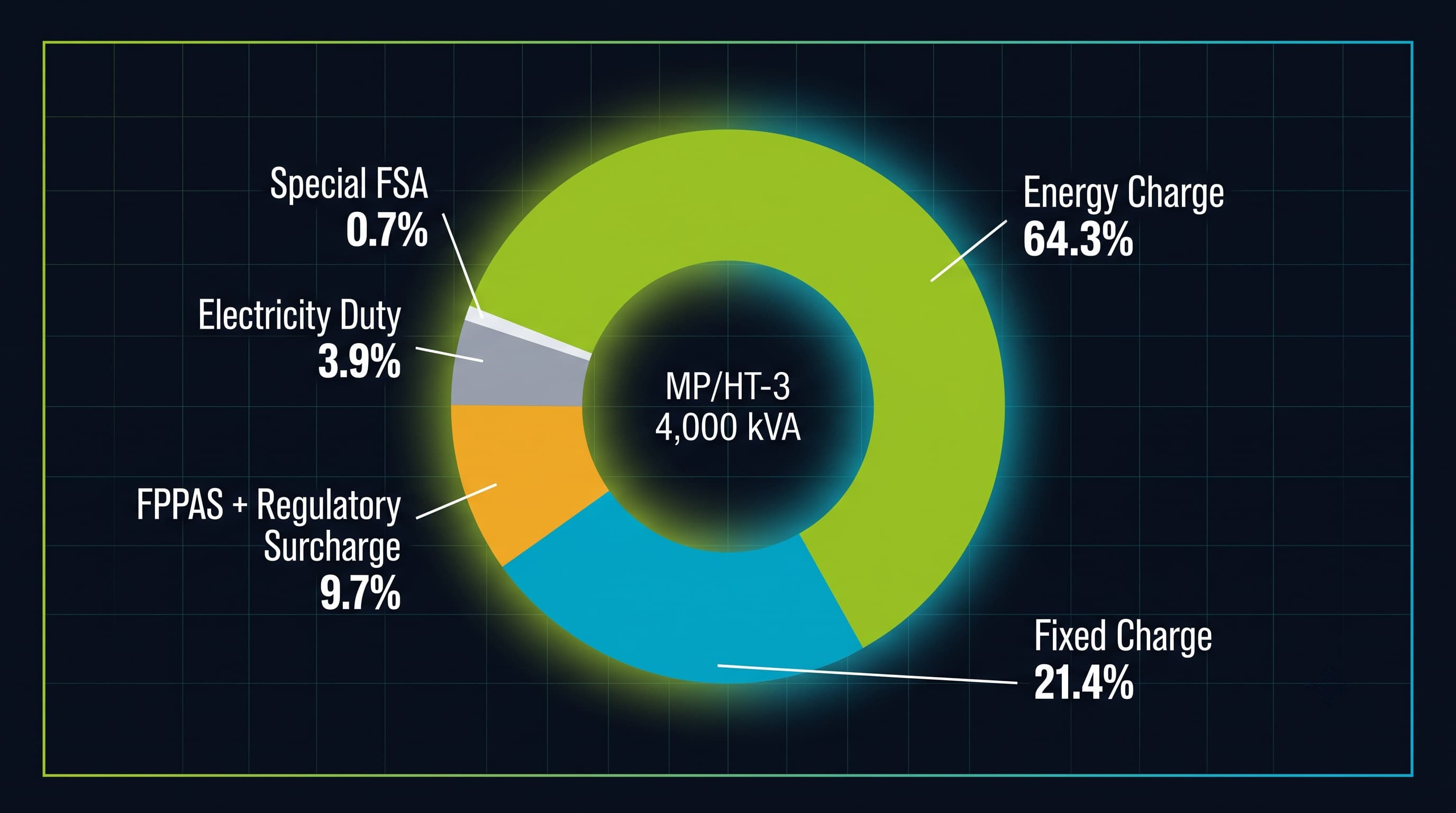
Energy Charge dominates both bills, as expected — but the statutory and regulatory add-ons (Duty, FPPAS/Regulatory Surcharge, Special FSA) together account for roughly 14% of the industrial bill and 12% of the commercial bill, a meaningful share that a headline per-unit rate alone won't surface.
The Pecking Order for Solar Surplus
Every section above points toward the same underlying question: once solar is on site, what actually happens to a unit of surplus generation, and what is it worth? Ranked from most to least valuable:
| Rank | Option | What Happens | Illustrative Value |
|---|---|---|---|
| 1 | Direct self-consumption | Solar offsets grid draw in real time | Full avoided cost: ₹5.85–7.15/unit depending on ToD block |
| 2 | Banking (within the ceiling) | Surplus injected, drawn back later, 8% charge deducted | ≈ 92% of avoided cost — the base rate minus the banking charge |
| 3 | Storage, discharged at evening peak | Surplus stored instead of exported or banked, used to offset the priciest block | Full evening-peak avoided cost: up to ₹7.15–9.35/unit, and RPO-eligible |
| 4 | Export beyond the banking ceiling | Sold to the DISCOM at the generic solar procurement rate | ≈ ₹2.00–2.50/unit — a fraction of retail value |
| 5 | Unrecovered / curtailed | No mechanism arranged to capture it | ₹0 |
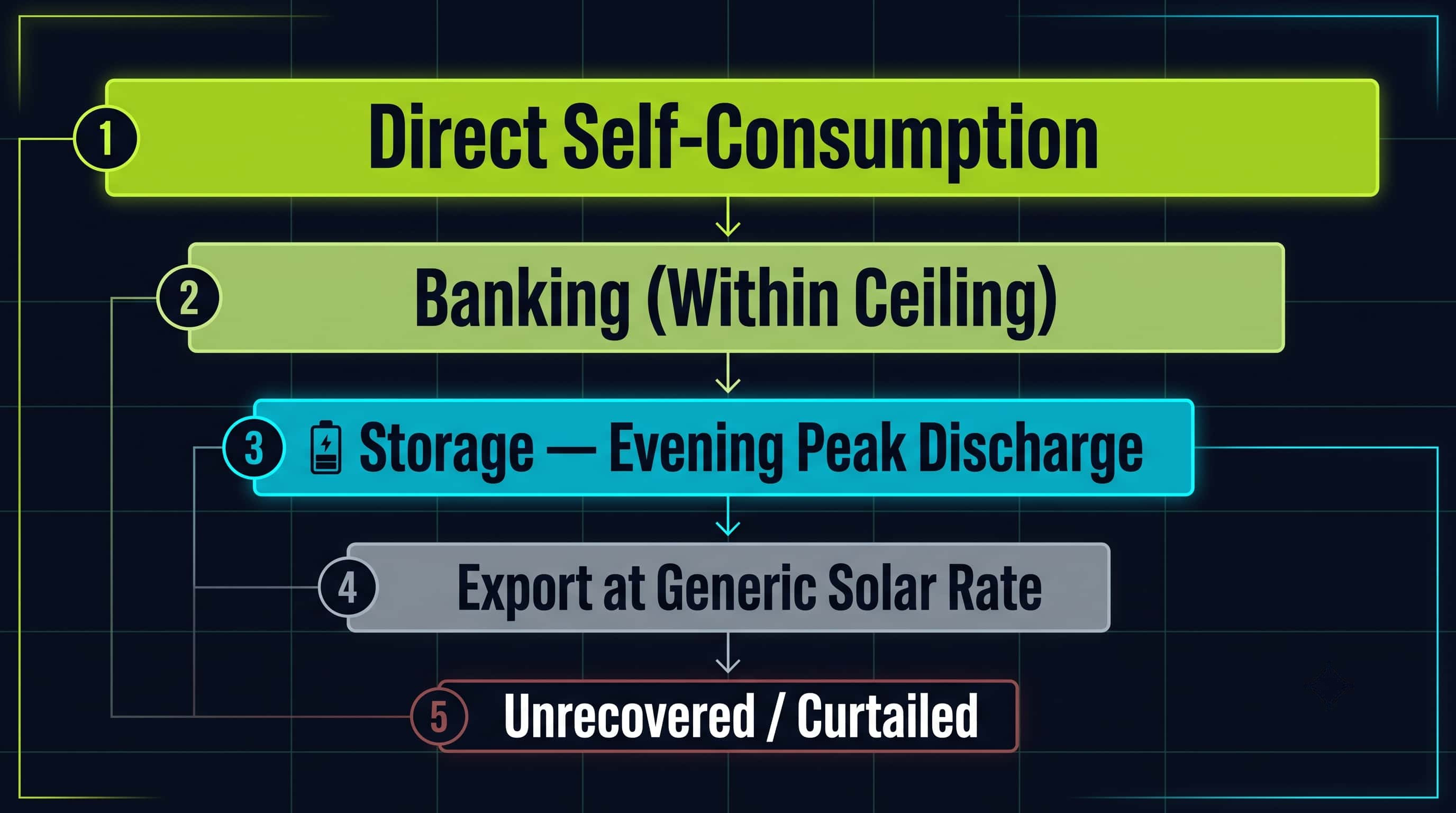
Options 1, 2, and 4 are available today with solar alone. Option 5 is what happens by default when nobody plans for excess generation. Option 3 is the one this article can describe but can't resolve on its own — it requires storage, sized and dispatched correctly, and it's the subject of Part 2: how a correctly sized Battery Energy Storage System addresses the Time of Day surcharge exposure, the banking ceiling, and the wheeling charges set out above, and how Rajasthan's current wheeling waiver applies.
Read the storage-based analysis in Part 2: Battery Storage (BESS) for Rajasthan Solar — The C&I Blueprint.
Frequently Asked Questions
Common questions from Rajasthan C&I energy buyers about RERC tariff categories, ToD adjustments, and solar banking.
See What Fits Your Load
125kW to 500kW+, zero capex. Browse the PX-125 and PX-500.