The Wrong Question Is Costing You Crores
Most energy managers in Maharashtra's commercial and industrial sector are solving the wrong problem. They review their monthly MSEDCL bill, identify the largest line items, and ask: "How do I reduce this number?" It is a reasonable instinct — but it is the wrong frame. The bill is the outcome. The decision that determines the outcome happens long before the meter reads.
The right question is sharper, and it applies equally to a 200 kW hotel in Pune, a 2 MW auto-components plant in Aurangabad, and a 5 MW data centre in Mumbai:
This is a strategic electricity procurement question. And Maharashtra's regulatory architecture under the REES Policy 2025-36 has created one of the most favourable arbitrage windows for commercial energy buyers.
The tariff trajectory through FY 2029-30 is already set. Demand charges are rising. The ToD spread is locked in. And the consumers who structure their energy procurement around this framework today will hold a structural cost advantage over those who do not — for the next decade.
What You Are Actually Paying
Before calculating the opportunity, you must have clarity on the cost you are trying to avoid. For HT and large commercial consumers in Maharashtra, the electricity bill has two distinct layers — and the most important one is the one most people stop reading past.
The Four Time Slots That Define Every Rupee
Maharashtra's Time-of-Day tariff structure divides every 24-hour period into four slots. The MERC 5th Control Period MYT Order applies a percentage-based adjustment to the Energy Charge depending on the slot — a rebate during solar hours to encourage load shifting, and a surcharge during evening peak to discourage grid draw when thermal generation is most expensive.
| ToD Slot | Hours | HT I-A Industry | HT II Commercial | HT VIII-B Public Services | LT II Commercial (>50 kW) |
|---|---|---|---|---|---|
| Night – Neutral | 0000–0600 | ₹9.42 | ₹14.77 | ₹12.30 | ₹16.61 |
| Morning – Neutral | 0600–0900 | ₹9.42 | ₹14.77 | ₹12.30 | ₹16.61 |
| Solar Hours (Apr–Sep) | 0900–1700 | ₹8.12 | ₹12.67 | ₹10.57 | ₹14.23 |
| Solar Hours (Oct–Mar) | 0900–1700 | ₹7.25 | ₹11.26 | ₹9.41 | ₹12.64 |
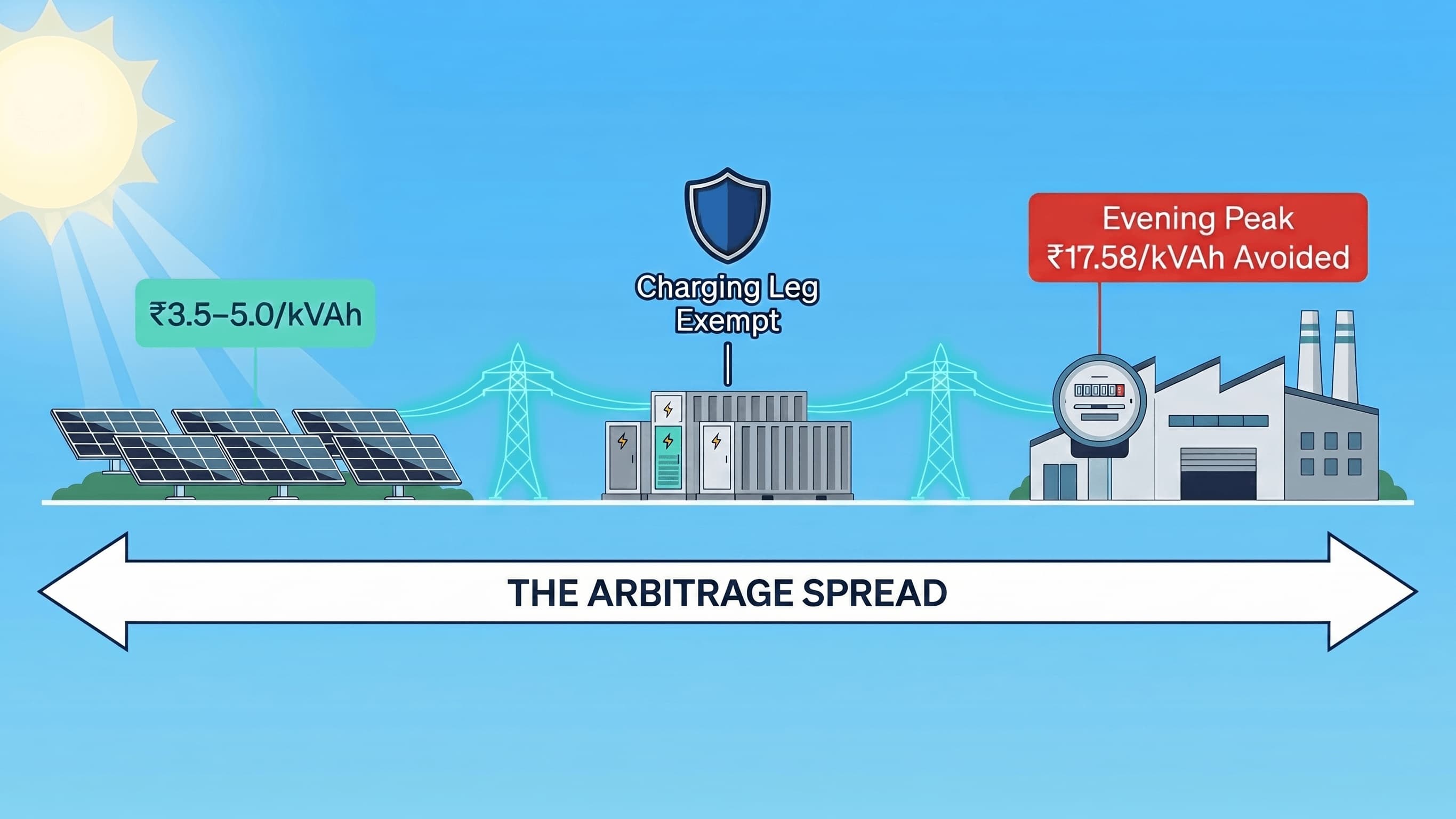
| ⚡ Evening Peak | 1700–2400 | ₹11.16 | ₹17.58 | ₹14.61 | ₹19.78 |
Source: MERC MYT Order, 5th Control Period; MSEDCL ToD Tariff Schedule FY 2025-26. Rates in ₹/kVAh (Energy Charge + Wheeling).
The Demand Charge: The Fixed Cost BESS Can Attack Directly
Beyond the per-unit ToD rates sits a charge that many energy managers treat as unavoidable overhead: the Fixed Demand Charge of ₹600/kVA/month, levied on your sanctioned load regardless of whether you draw a single unit during the month.
A BESS system that discharges during your facility's 15-minute peak demand intervals directly reduces the recorded peak kVA on your billing meter. It is not a theoretical benefit — it is a line item reduction on your next bill. Taken together, the evening peak per-unit surcharge and the fixed demand charge represent the "expensive avoided cost" side of the arbitrage equation.
Three Procurement Options, the Spread, and What Rooftop Solar Can and Cannot Do
The spread between what you pay to charge a BESS and what you avoid by not drawing from the grid during the evening peak is the entire financial engine of this strategy. Three sources are available — not competing alternatives, but a priority stack used in sequence.
The Three Sources at a Glance
| Source | Effective Landed Cost | Key Constraint |
|---|---|---|
| Rooftop Solar (BTM) | ₹0.50–1.0/kVAh (after GSC) | Physically constrained by roof area and load profile |
| Group Captive OA Solar | ₹3.5–5.0/kVAh (PPA; no CSS; charging leg exempt) | Proportionate equity required; 51% consumption rule applies |
| Grid – Solar Hours (0900–1700) | ₹7.25–8.12/kVAh (after 15–25% rebate) | Floor option; spread narrows but remains positive |
The Pecking Order: Spread = Procurement Cost vs. Evening Peak Avoided Cost
| Priority | Charging Source | Cost (₹/kVAh) | HT I-A Avoided | HT II Avoided | LT II Avoided | Spread |
|---|---|---|---|---|---|---|
| 1 | Rooftop solar surplus | ₹0.50–1.0 | ₹11.16 | ₹17.58 | ₹19.78 | ₹10–19/kVAh |
| 2 | Group Captive OA solar | ₹3.5–5.0 | ₹11.16 | ₹17.58 | ₹19.78 | ₹6–16/kVAh |
| 3 | Grid solar-hour (Oct–Mar) | ₹7.25–12.64 | ₹11.16 | ₹17.58 | ₹19.78 | ₹3.9–7.1/kVAh |
| 4 | Grid solar-hour (Apr–Sep) | ₹8.12–14.23 | ₹11.16 | ₹17.58 | ₹19.78 | ₹3.0–5.5/kVAh |
| 5 ⚠️ | Grid night/morning (fallback) | ₹9.42–16.61 | ₹11.16 | ₹17.58 | ₹19.78 | ₹1.7–3.2/kVAh |
Gross spread before ~10% LFP round-trip efficiency loss. Net spread remains positive for Priorities 1–4 across all categories. Priority 5 should be used only as a last resort — after efficiency losses and operating costs, the margin becomes structurally thin.
Rooftop Solar: The Role Depends on Your Load Profile
| Consumer Type | Daytime Load vs. Solar Output | Rooftop Role | Primary BESS Charging Strategy |
|---|---|---|---|
| HT Industrial, cold storage, data centres, logistics | Continuous, high — solar fully consumed BTM, zero surplus | Cost offset only | Group Captive OA → grid solar-hour window |
| Hotels, resorts, hospitality | Moderate daytime, heavy evening/night — creates real surplus | Primary BESS charging; LT II spread reaches ₹19/kVAh | Rooftop surplus → grid solar-hour; OA for scale |
| Mixed commercial, hospitals, institutions | Moderate daytime — partial surplus, more on weekends | Partial top-up | Rooftop surplus + Group Captive OA → grid solar-hour |
The GSC Trap: You Pay It Whether You Export or Not
One cost applies to every rooftop solar system above 10 kW regardless of load profile: the Grid Support Charge (GSC), levied on gross generation — not on net export or banking. A facility consuming 100% of its solar behind the meter, banking nothing, still pays GSC in full.
At ₹1.40/kVAh on gross generation for HT consumers, a 900 kWp system generating 1,08,000 kVAh/month carries a GSC liability of ₹1.51 lakh/month — ₹18.1 lakh/year. The net economics remain positive, but the effective rooftop cost is ₹0.50–1.0/kVAh, not zero. Every PWRNXT feasibility model applies GSC on gross generation from the first unit.
The Regulatory Provision That Protects the Spread
A spread of ₹6–19/kVAh is only valuable if the act of storing energy does not itself generate a new layer of charges that erodes it. This was, historically, the structural problem with grid-charged BESS: every unit drawn to charge a battery attracted transmission charges, wheeling charges, electricity duty, and cross-subsidy surcharge — a pile-on that made the arbitrage illusory.
The Maharashtra REES Policy 2025-36 resolves this with a single, precisely worded provision that most energy buyers in the state have not fully read, let alone priced into their investment decisions.
The Intermediate Storage Exemption
Section 5.1 of the REES Policy 2025-36 establishes ESS as a unique asset class and defines the charging leg accordingly:
Four charges are waived on every unit a BESS draws for storage, FY 2025-26:
| Charge Waived | Rate (₹/kVAh) | Applicability |
|---|---|---|
| InSTS Transmission Charge | ₹0.47 | All scenarios — grid, OA, captive |
| Wheeling Charge | ₹0.74 | All scenarios |
| Electricity Duty | ₹0.16 | All scenarios (charging leg only) |
| Cross-Subsidy Surcharge | ₹1.60–₹2.50 | Third-party OA only; Group Captive already exempt under EA 2003 S.9 |
| Total Waiver Stack | ₹2.97 → ₹3.87/kVAh | Group Captive / grid → third-party OA commercial |
Without this exemption, a Group Captive OA consumer charging their BESS would pay PPA rate (₹3.5–5.0/kVAh) plus wheeling (₹0.74) + transmission (₹0.47) + ED (₹0.16) — an effective charging cost of ₹4.87–6.37/kVAh. With the exemption, they pay only the PPA rate. That ₹1.37/kVAh preserved margin, at 2 cycles/day for a 600 kWh BESS, translates to ₹16–20 lakh per year in value that exists solely because of this provision.
The condition is automatic for any fixed-site consumer within Maharashtra: stored energy must be consumed within the state. The exemption applies to the charging leg only — the discharge leg is billed at the consumer's normal applicable tariff. This is the intended design.
Where BESS Sits: The Decision That Determines How Much of the Spread You Actually Keep
The intermediate storage exemption protects the charging leg regardless of where the BESS is located. But location determines everything about the discharge leg — and the discharge leg is where value is either fully captured or structurally leaked.
Charge Structure: Co-Located vs. BTM
| Co-Located BESS (at OA solar plant) | BTM BESS (at consumer premises) | |
|---|---|---|
| Charging leg | Exempt — intermediate storage waiver | Exempt — intermediate storage waiver |
| Discharge / Delivery leg | OA delivery charges apply — wheeling + TC ₹1.1–1.3/kVAh (CSS-exempt for captive) | Zero — discharge is behind the billing meter, no grid traversal |
| Annual delivery-leg drag | ₹14–18L/year (600 kWh BESS, 2 cycles/day) | Nil |
Value Lever Comparison
| Value Lever | Co-Located BESS | BTM BESS |
|---|---|---|
| Evening peak avoidance | Partial — subject to InSTS scheduling, DSM norms | ✅ Full — EMS dispatches on real-time ToD clock |
| Demand charge shaving (15-min) | ❌ Not possible — remote from billing meter | ✅ Direct — discharges during peak demand intervals |
| kVAh / Power Factor correction | ❌ Not possible at consumer meter | ✅ Inverter injects reactive power at HT metering point |
| Rooftop solar integration | ❌ Cannot charge from rooftop solar at consumer site | ✅ Charges from rooftop surplus — zero-cost charging |
| Grid outage backup | ❌ Remote site — no backup to consumer | ✅ UPS-grade backup for critical loads |
| Regulatory complexity | Higher — DSM, forecasting & scheduling compliance | Lower — single BTM meter behind HT billing point |
| Best suited for | Utility-scale dispatch, DISCOM tenders, firmer OA delivery | C&I value maximisation — full five-lever capture |
The Two-BESS Architecture: Not a Duplication, a Division of Labour
From April 2026, Group Captive OA solar projects seeking grid connectivity carry a mandatory storage requirement: 50% of RE capacity at minimum 2-hour duration. A BESS co-located at the solar plant meets this compliance obligation. A BTM BESS at the consumer premises captures the full commercial value stack. Both can co-exist. Each serves a distinct regulatory and commercial function.
| BESS 1 — Co-located at Solar Plant | BESS 2 — BTM at Consumer Premises | |
|---|---|---|
| Primary function | Mandatory compliance for OA RE project connectivity; firmer evening OA delivery | Full C&I value capture — peak avoidance, demand shaving, PF correction, backup |
| Sizing | 50% of RE capacity, 2-hour minimum | Sized to facility load profile and arbitrage economics |
| Ownership | Project developer / RESCO | Consumer / PWRNXT |
| Who procures | Solar developer's obligation | PWRNXT's product |
Right-Sizing Your BESS: The 2-Hour vs. 4-Hour Decision
Of all the configuration decisions in a BESS project, the one most often made reflexively — and least often modelled rigorously — is duration. Two hours or four hours? The policy creates a financial incentive to go longer. The capex arithmetic creates a reason to pause. The right answer depends on your consumption volume.
The Mandatory Baseline: What April 2026 Requires
From April 2026, any consumer above 100 kW installing rooftop solar or entering a Group Captive OA arrangement must integrate a minimum level of storage: 50% of RE capacity at 2-hour duration. This is the compliance floor. A 1 MWp rooftop solar installation mandates a 500 kW / 1,000 kWh BESS. This mandatory 2-hour BESS already serves the primary arbitrage purpose — charging during solar hours, discharging during the 1700–2100 portion of the evening peak.
The 4-Hour Upgrade: What It Unlocks
The REES Policy 2025-36 grants a 10-year Electricity Duty exemption on all captive OA consumption to consumers who configure their qualifying storage at 4-hour duration (50% of RE capacity). The exemption applies not just to BESS charging throughput — but to the facility's entire captive OA consumption for a decade.
The Honest Cost-Benefit: At What Scale Does It Work?
Going from 2-hour to 4-hour adds approximately ₹2 Crore in BESS capex per additional 2 MWh of capacity. Modelling both value streams over 10 years at 10% WACC:
| Facility Size | Annual Captive Consumption | ED Saving/yr | 10-yr ED PV (@10%) | 10-yr Arbitrage PV | Total PV | vs. ₹2 Cr Extra Capex |
|---|---|---|---|---|---|---|
| 500 kW, 24×7 | 3.5 MU | ₹5.6L | ₹0.34 Cr | ₹1.29 Cr | ₹1.63 Cr | ❌ Falls ₹37L short |
| 1 MW, 24×7 | 7.0 MU | ₹11.2L | ₹0.69 Cr | ₹1.29 Cr | ₹1.98 Cr | ❌ Marginally short |
| 1.5 MW, 24×7 | 10.5 MU | ₹16.8L | ₹1.03 Cr | ₹1.29 Cr | ₹2.32 Cr | ✅ Recovers |
| 2 MW, 24×7 | 14.0 MU | ₹22.4L | ₹1.38 Cr | ₹1.29 Cr | ₹2.67 Cr | ✅ Recovers comfortably |
Basis: 10% WACC; 300 operating days/year; grid solar-hour charge ₹8.12/kVAh with -15% rebate; RTE 90%; evening peak avoided at ₹11.16/kVAh (HT I-A). For HT II Commercial and LT II Commercial, the wider ToD spread improves arbitrage PV further — write to contact@pwrnxt.in for a category-specific model.
The Sizing Decision Framework
| Facility Profile | Recommended Configuration | Rationale |
|---|---|---|
| Below 1 MW continuous load | 2-hour BESS (mandatory compliance minimum) | 4-hour upgrade does not recover ₹2 Cr extra capex; revisit at expansion |
| 1–1.5 MW continuous load | 2-hour now, modular 4-hour expansion planned | Borderline case; lock in design for future expansion without upfront capex |
| Above 1.5 MW continuous load | 4-hour BESS from commissioning | ED exemption + incremental arbitrage comfortably recover upgrade cost |
| HT II Commercial / LT II (>50 kW) | Lower threshold — reassess at 1 MW | Higher evening peak tariff (₹17.58–₹19.78/kVAh) improves arbitrage PV; breakeven shifts lower |
The Strategic Synthesis: Answering the Question
This article began with a question: what is the cheapest, most reliable way to land electrons at your meter — and how does BESS maximise the spread? The answer, under Maharashtra's current regulatory architecture, is now fully defined.
The Spread, Assembled
| Decision Layer | The Answer |
|---|---|
| Most expensive avoided cost | Evening peak grid tariff: ₹11.16/kVAh (HT Industry) → ₹19.78/kVAh (LT II Commercial) + Fixed Demand Charge ₹600/kVA/month |
| Cheapest procurement source | Rooftop solar surplus (₹0.50–1.0/kVAh) → Group Captive OA solar (₹3.5–5.0/kVAh) → grid solar-hour window (₹7.25–8.12/kVAh) |
| Gross spread available | ₹6–19/kVAh depending on consumer category and charging source |
| Regulatory protection on charging leg | ₹2.97–3.87/kVAh in waived charges — spread preserved end-to-end |
| Location that maximises discharge value | BTM at consumption site — zero delivery-leg charges, full five-lever value capture |
| BESS sizing discipline | 2-hour for sub-1.5 MW facilities; 4-hour for 1.5 MW+ where ED exemption + arbitrage recover upgrade capex |
Why This Opportunity Is Durable, Not Cyclical
Some arbitrage windows close as markets correct. This one is structurally reinforced by the tariff trajectory MERC has already approved through FY 2029-30:
- Energy charges are falling — cheaper renewable procurement passes through to consumers — but the differential between solar-hour discounts and evening-peak surcharges is maintained and steps up further from FY 2027-28 onwards.
- Fixed demand charges are rising — ₹600 to ₹750/kVA/month by FY 2029-30 — making the BESS demand-shaving lever more valuable with each passing tariff year.
- The 10-year ED exemption window is open now — consumers who commission qualifying configurations in the near term lock in a decade of benefit; those who wait lose years of exemption period with no compensating advantage.
Four Questions Every HT Consumer Should Answer Today
PWRNXT's techno-commercial feasibility framework is built to answer all four questions for your specific facility — load profile, tariff category, roof assessment, OA structuring, BESS sizing, and a ten-year cash flow model that puts a rupee figure on every lever discussed in this article.
The spread exists. The regulation protects it. The question is whether you are structured to capture it.
Get a Facility-Specific Feasibility Assessment
Load profile analysis · Tariff category modelling · Roof & OA structuring · BESS sizing · 10-year cash flow model. Delivered in 5 business days. Zero cost.
Data Sources: All tariff data sourced from MERC MYT Order (5th Control Period, FY 2025-26 to FY 2029-30) and the Maharashtra Renewable Energy and Energy Storage Policy 2025-36.
The interpretation of policy provisions, tariff orders, regulatory rules, and exemptions set out in this article reflects PWRNXT's reading of publicly available documents at the time of writing. Regulatory language is often subject to differing interpretation, and positions taken here may not align with views held by MERC, MSEDCL, other regulators, or legal counsel. We actively encourage readers — including consumers, practitioners, developers, and advisors — to share alternative interpretations or factual corrections. Please write to us at contact@pwrnxt.in; we will review and update this article accordingly.
Important notice for investors and project developers: This article is a strategic and educational resource and is not intended to constitute, and must not be relied upon as, investment advice, project feasibility assurance, or a solicitation for investment of any kind. Investors and developers should conduct their own independent due diligence — including legal, regulatory, financial, and technical assessments specific to their projects — before making any investment or procurement decision. PWRNXT makes no representation as to completeness, accuracy, or fitness for any particular purpose, and accepts no liability for decisions taken in reliance on the information contained herein.