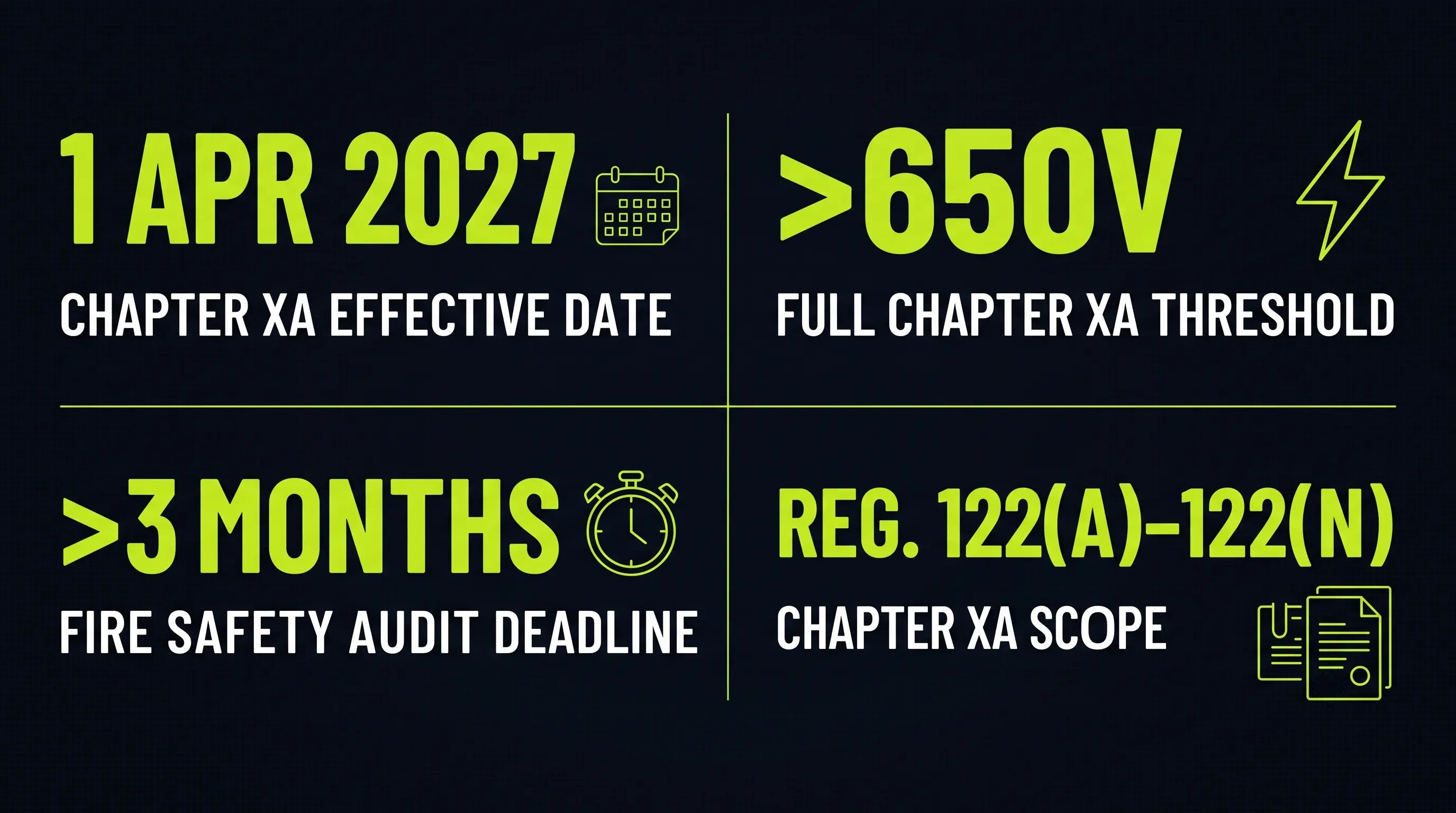
For the first time, India's Central Electricity Authority has written a safety chapter specifically for battery energy storage systems, rather than leaving BESS to be read into general electrical safety rules that were never drafted with lithium-ion racks or containerised power electronics in mind. The amendment — the Central Electricity Authority (Measures relating to Safety and Electric Supply) Amendment Regulations, 2026 — was notified via Gazette of India No. 231 on 27 March 2026, and takes effect on 1 April 2027 (Reg. 1(2)).
What Counts as a "Battery Energy Storage System" Now
Four new defined terms anchor the whole chapter
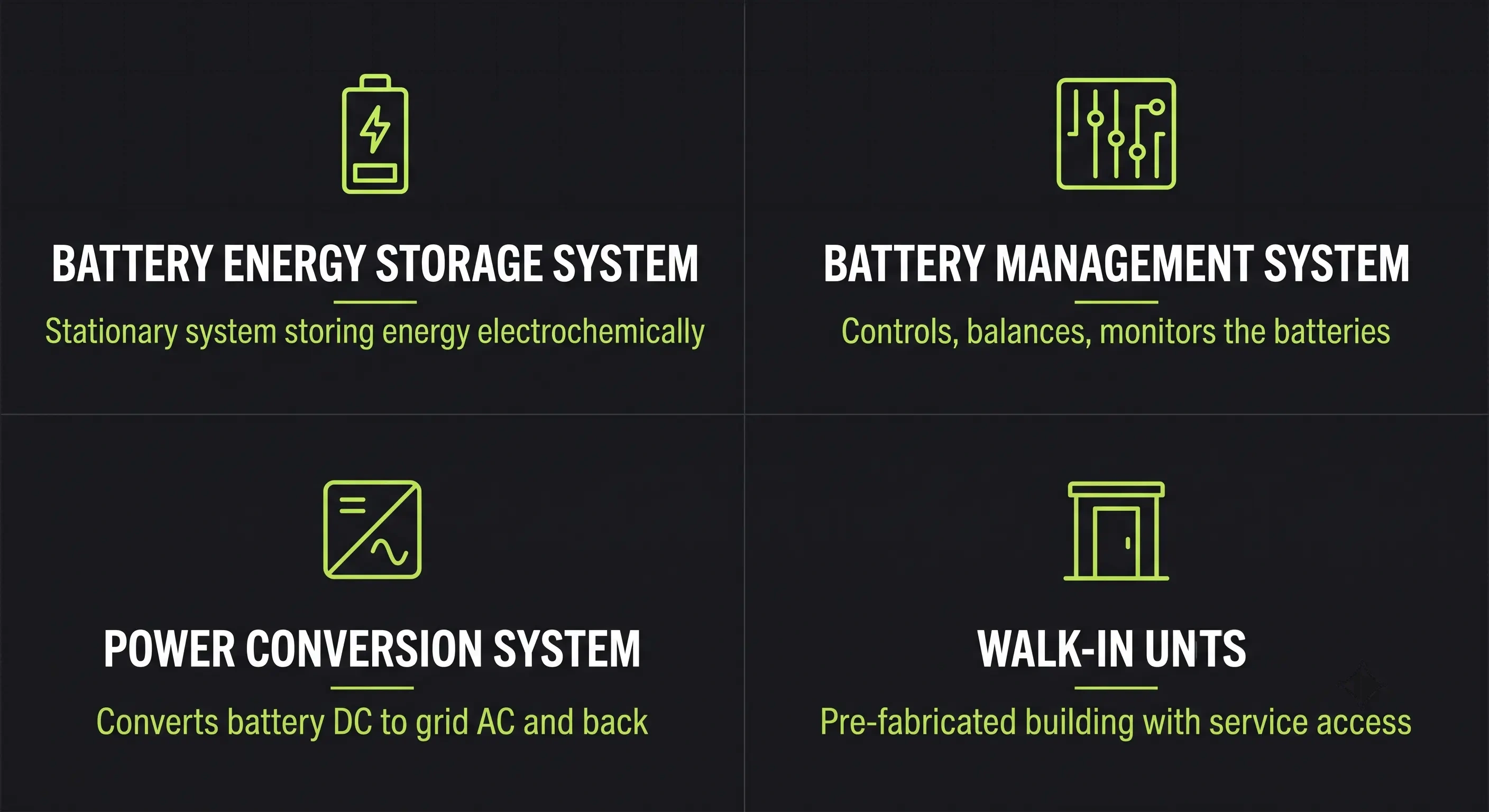
The amendment inserts four new definitions into Regulation 2(1) — the terms the rest of Chapter XA is built on:
- Battery Energy Storage System [Reg. 2(1)(ea)]: a stationary system, connected to the electricity system, used to store electric energy by means of electrochemical materials — typically comprising batteries, a power conversion system, and a battery management system.
- Battery Management System [Reg. 2(1)(eb)]: a system that controls the batteries to achieve safe operation, balances their energy, and monitors their status.
- Power Conversion System [Reg. 2(1)(zza)]: the integrated system of inverters, rectifiers, controllers, and associated power electronics that converts the battery's stored DC power to AC for injection into the electricity system (discharging), and back again (charging).
- Walk-in Units or System [Reg. 2(1)(zzoa)]: a pre-fabricated building housing a BESS, with doors that give personnel walk-in access to maintain, test, and service the equipment.
The New Rulebook: Chapter XA at a Glance
Fourteen sub-regulations, one voltage threshold that decides which apply
Chapter XA sits in addition to Chapters I–VII and XIV of the 2023 Regulations (Reg. 122(A)) — it doesn't replace the general safety rules, it layers BESS-specific ones on top.
| Clause | Requirement | Applicability |
|---|---|---|
| 122(A) | Chapter XA applies in addition to Chapters I–VII and XIV | All BESS covered by this chapter |
| 122(B) | Two-fault tolerant design; BMS monitoring at cell/module/rack level; PCS auto sync/disconnect | >650V |
| 122(C) | Explosion protection, forced ventilation, automated louvers, ingress protection, walk-in unit access | >650V |
| 122(D) | Minimum spacing between adjacent enclosures and nearest building, by chemistry | >650V |
| 122(E) | HVAC/cooling for thermal management; flammable-gas concentration control; auto shutdown on ventilation failure | >650V |
| 122(F) | Smoke/gas/heat/flame detection; automatic fire suppression per container | >650V |
| 122(G) | Electrolyte spill containment for liquid acidic/basic electrolytes | >650V |
| 122(H) | Emergency lighting with automatic initiation; safety signage | >650V |
| 122(I) | Perimeter fencing ≥1.8m; CCTV/motion/break-glass sensors tied to a monitoring-response system | >650V |
| 122(J) | Automatic shutdown of the affected section; manual emergency stop buttons | >650V |
| 122(K) | Equipment earthing per relevant standard | >650V |
| 122(L) | Authority may issue new technical specifications for new technologies | Emerging BESS technologies |
| 122(M) | Independent third-party fire safety audit within 3 months of commencement; owner submits report to Electrical Inspector; fire officials to be trained | >650V (owner obligation) |
| 122(N) | Compliance with relevant standards (list to be issued under Reg. 137) | ≤650V |
ℹ Source: CEA (Measures relating to Safety and Electric Supply) Amendment Regulations, 2026, Regulations 122(A)–122(N) and 137.
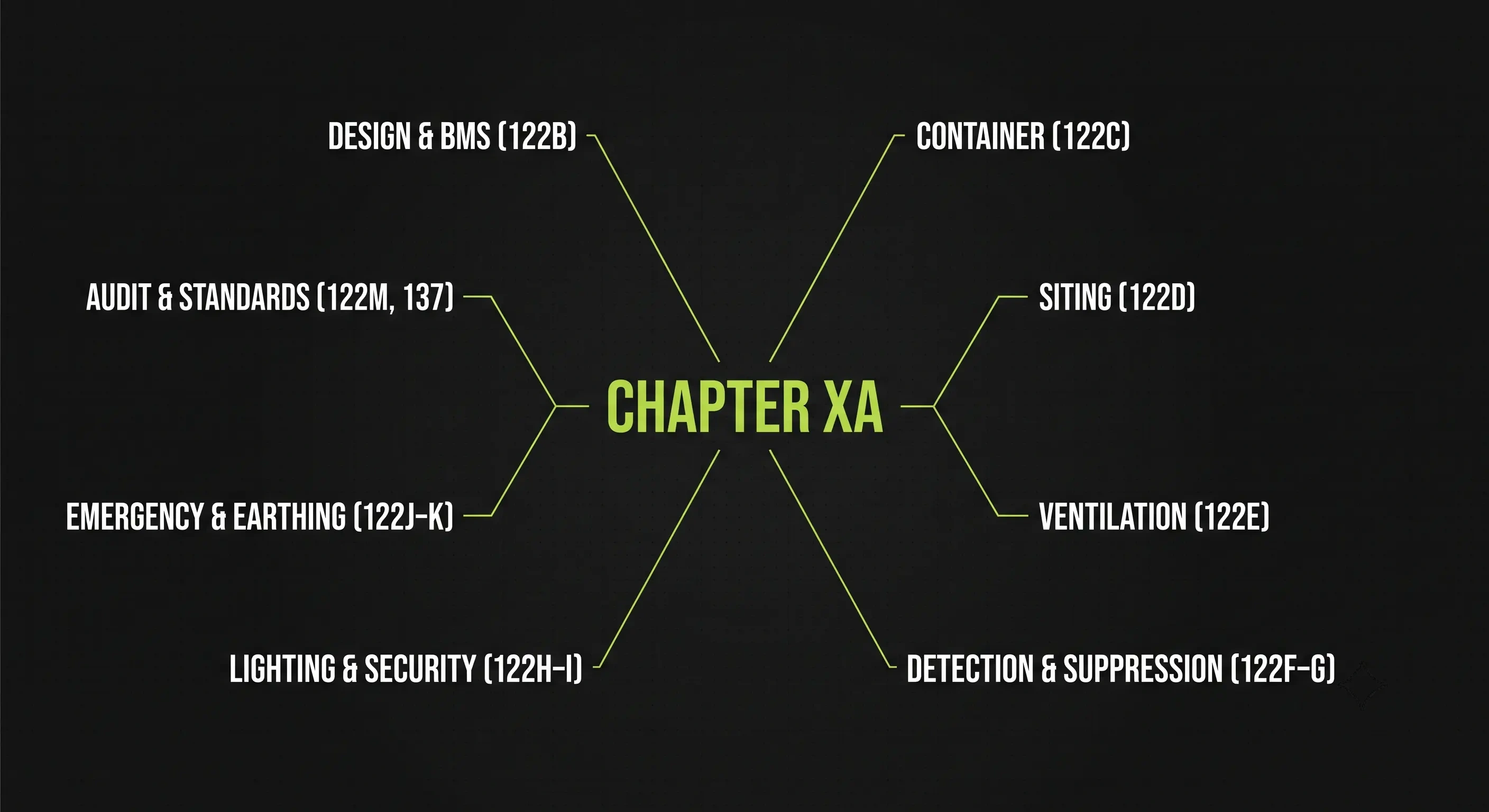
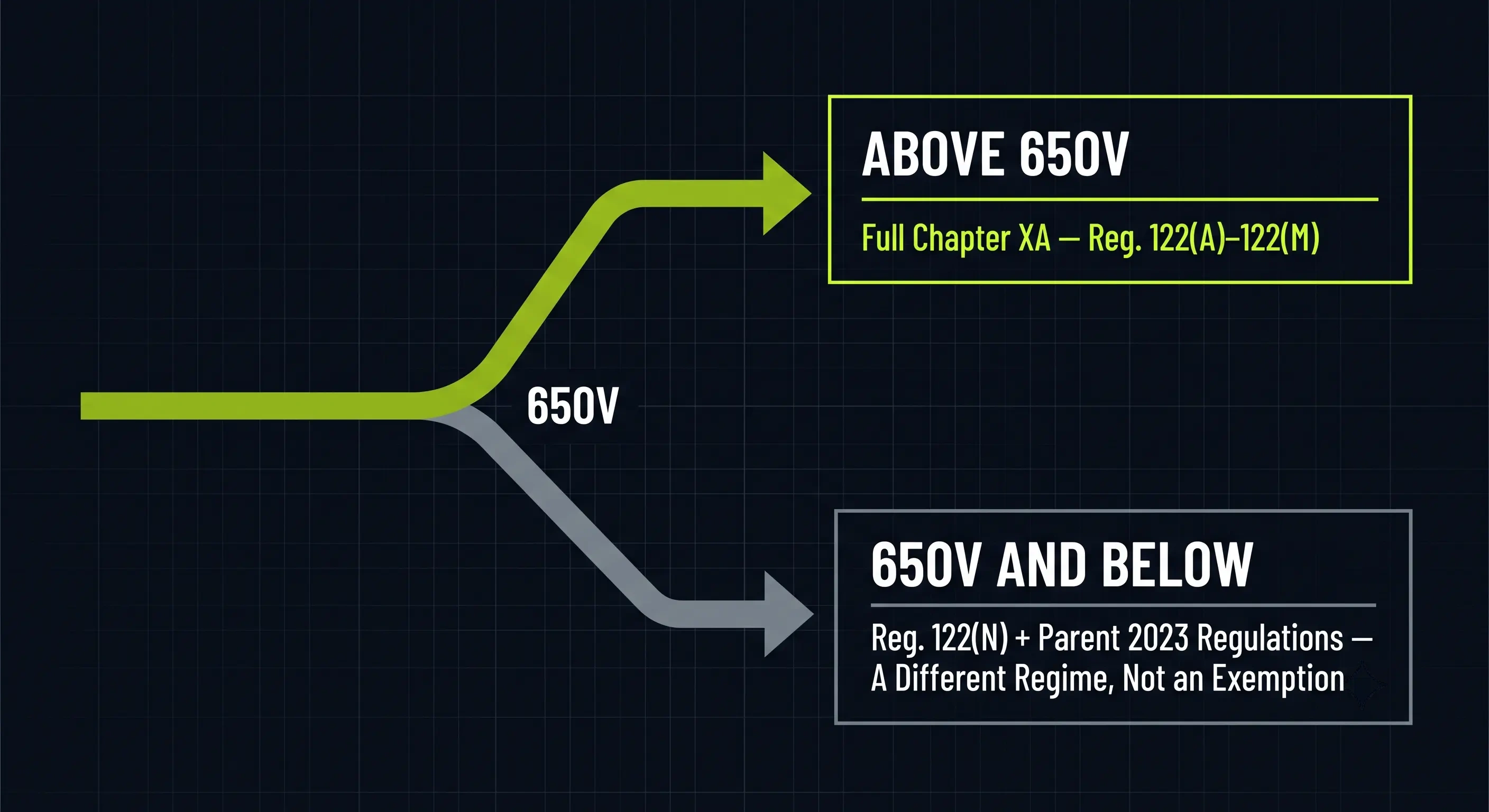
The binding threshold: the Explanation appended after Regulation 122(M), applicable to the whole chapter, states that Regulations 122(A)–122(M) apply only to BESS "connected at voltage level exceeding 650 V." Installations at 650V and below fall instead under Regulation 122(N), which only requires compliance with "relevant standards" generically — a materially lighter regime.
The 650V Reality Check: Not an Exemption
What "compliant to relevant standards" under Regulation 122(N) actually requires
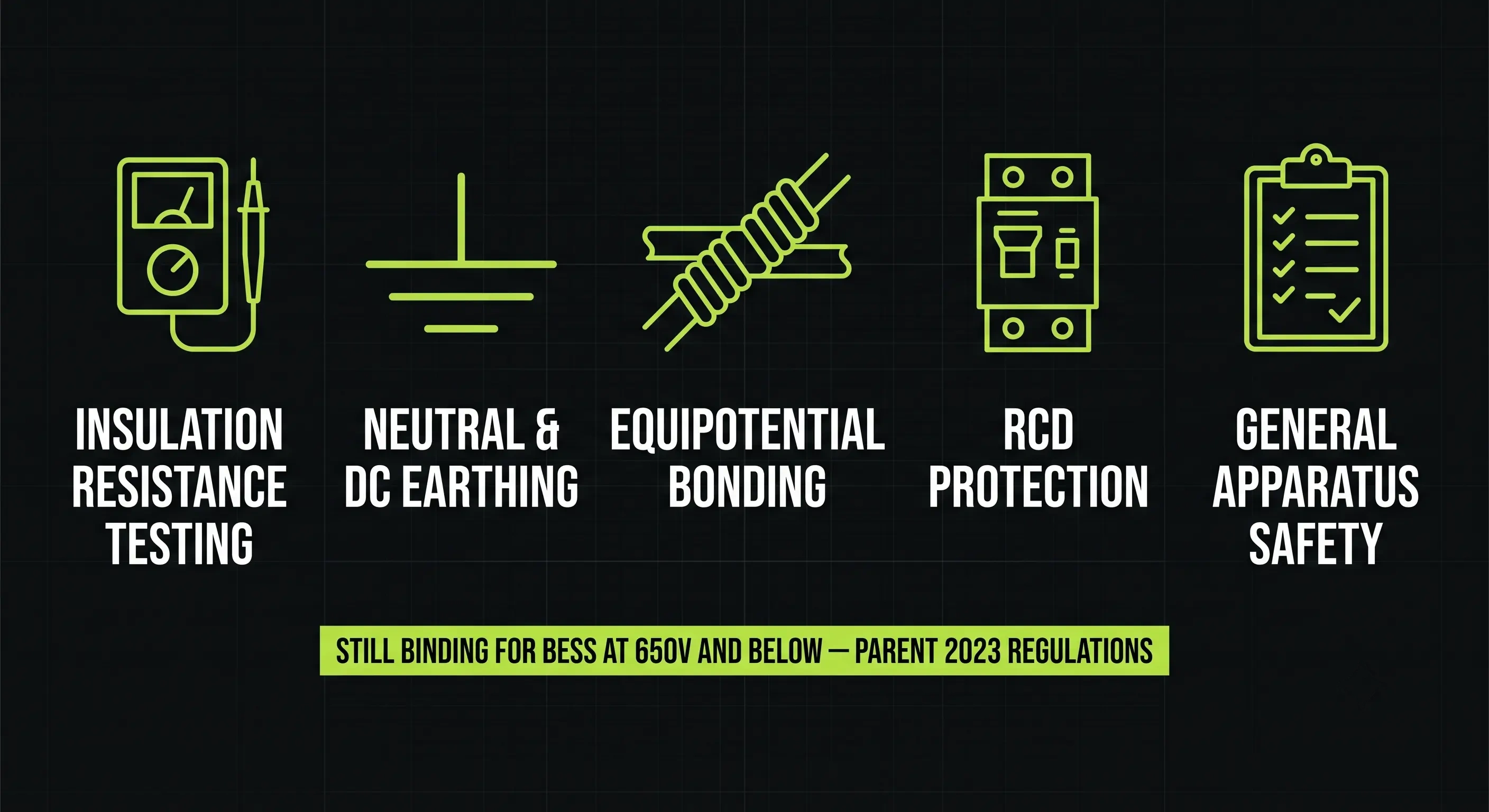
It's tempting to read Regulation 122(N) — one sentence, no prescriptive detail — as a light-touch carve-out for smaller installations. It isn't one. Regulation 122(A) states that the whole of Chapter XA, which includes 122(N), applies "in addition to" Chapters I–VII and XIV of the parent CEA (Measures relating to Safety and Electric Supply) Regulations, 2023 — and that additive language isn't restricted to installations above 650V. A BESS at or below 650V skips Chapter XA's new prescriptive detail (two-fault tolerance, BMS monitoring duties, fencing, the fire audit), but it remains fully bound by the general electrical safety framework that already governed every electrical installation in India before this amendment existed.
For a ≤650V BESS, the operative rulebook is primarily Chapter V of the parent 2023 Regulations ("Safety provisions for electrical installations and apparatus of voltage not exceeding 650V"), plus general safety requirements under Chapters III and IV. These aren't new — they're the pre-existing rules every low-voltage electrical installation in India already has to meet, and a BESS is no exception. The binding ("shall") requirements most relevant to a battery installation:
- Insulation resistance testing (Reg. 42): a disconnected supply line can't be reconnected until the supplier or owner has run an insulation resistance test.
- Neutral conductor earthing (Reg. 43(i)–(ii)): the neutral (or middle) conductor must be earthed per relevant standards, at one or more points along the distribution system or service line.
- DC earthing (Reg. 43(iv)): since batteries intrinsically operate on DC, earthing and safety measures for the DC side must follow relevant standards — directly applicable to a BESS's battery bank.
- Protective equipotential bonding (Reg. 43(v)): every building housing the BESS must bond exposed and extraneous conductive parts per relevant standards.
- Equipment frame earthing (Reg. 43(vii)): the frame of any apparatus regulating or controlling electricity — explicitly including a Power Conversion System or inverter chassis — must be earthed by two separate, distinct connections.
- Metal enclosure earthing (Reg. 43(viii)): metal casings or coverings protecting electric supply lines or apparatus — including BESS battery racks, cabinets, or enclosures — must be earthed and bonded across junction boxes.
- Earthing system technical standards (Reg. 43(ix)): earthing systems must carry prospective fault current safely, keep loop impedance low enough for protective devices to operate in time, and stay mechanically robust and corrosion-resistant.
- RCD protection (Reg. 44): the installation's electricity use must be controlled by a Residual Current Device sized and timed per relevant standards.
- General apparatus and safety duties (Chapters III–IV, Reg. 14(1), 23, 28, 37(2)): apparatus must be adequately rated and mechanically sound for its duty cycle; transportable/flexible cables need proper insulation and mechanical protection; AC and DC circuits must be arranged so neither becomes accidentally charged beyond its intended limit nor contacts the other; and isolation controls (a switch-fuse unit or circuit breaker) must sit as close as possible to the point of supply.
| Regulatory Parameter | BESS >650V | BESS ≤650V |
|---|---|---|
| Primary statutory rule | Regulations 122(A)–122(M), Chapter XA | Regulation 122(N), Chapter XA |
| Applicable standards | Explicit Chapter XA mandates plus "relevant standards" under Reg. 137 | "Relevant standards" only (Reg. 2(1)(zze) — BIS, then IEC/IEEE/EN) |
| Two-fault tolerance | Mandatory — Reg. 122(B)(2) | No explicit Chapter XA clause — governed by relevant standards |
| BMS monitoring duties | Mandatory — Reg. 122(B)(5) | No explicit Chapter XA clause — governed by relevant standards |
| Ventilation & explosion protection | Mandatory — Reg. 122(C), 122(E) | No explicit Chapter XA clause — governed by relevant standards |
| Independent fire safety audit | Mandatory within 3 months — Reg. 122(M)(1) | No statutory audit requirement specified |
| Earthing requirements | Reg. 122(K) ("as per relevant standard") | Reg. 122(N) plus parent Chapter V (Reg. 42, 43, 44) — detailed physical earthing rules |
ℹ Source: Regulations 122(A)–122(N) and 137 are cited from the CEA (Measures relating to Safety and Electric Supply) Amendment Regulations, 2026 (Gazette of India No. 231). The Chapter III/IV/V clause numbers (Reg. 2(1)(zze), 14(1), 23, 28, 37(2), 42, 43, 44) are cited from the parent CEA (Measures relating to Safety and Electric Supply) Regulations, 2023, as supplied for this article.
The Engineering Bar: Two-Fault Tolerance and BMS Duties
The design standard that decides whether a BESS is even eligible
Regulation 122(B)(2) requires that a BESS be designed with two-fault tolerance, so that it can "continue to operate safely or shut down safely" even after two independent faults have occurred — a requirement the regulation's own Explanation clarifies means the system's ability to keep functioning, or shut down safely, after two independent faults, not just one.
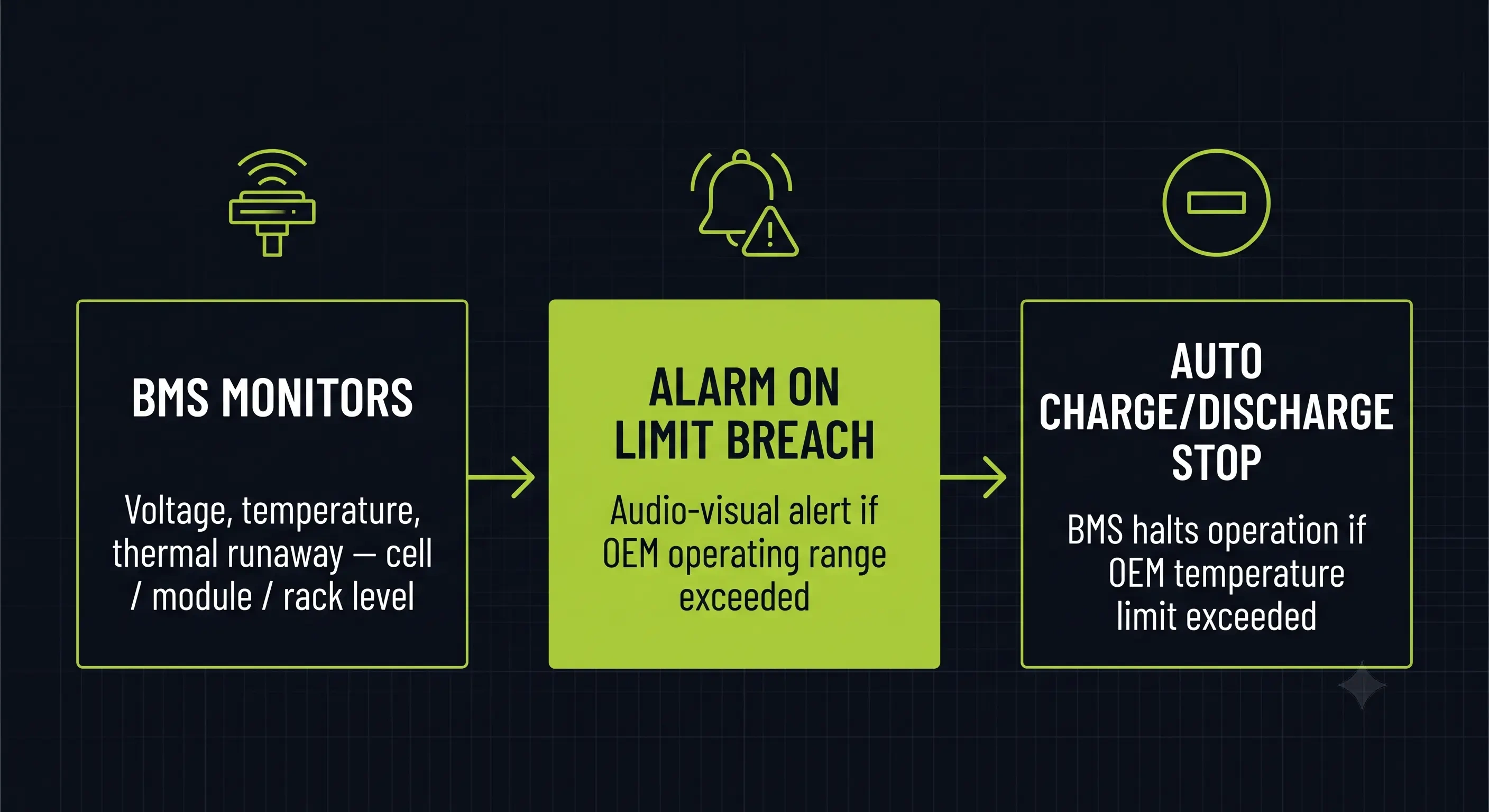
The Battery Management System carries the bulk of the monitoring duty. Regulation 122(B)(5)(a) requires it to monitor and record voltage, temperature, and thermal runaway at cell, module, and rack level, plus current at rack level. Two provisos make this binding rather than aspirational: an audio-visual alarm shall activate if a monitored parameter exceeds the OEM's specified operating range, and the BMS shall stop charging and discharging if temperature exceeds the OEM's recommended values.
The Power Conversion System has its own design bar: it must be designed for the specific battery chemistry it charges (Reg. 122(B)(1)), and it must be capable of fully automatic, unattended operation — including synchronising with and disconnecting from the electricity system — with self-protective and diagnostic features to guard against component failure and abnormal operating parameters (Reg. 122(B)(5)(b)). The regulation stops there; it doesn't specify a switching speed or an islanding capability, so any vendor claim about a specific response time should be checked against the vendor's own spec sheet, not assumed from the regulation.
Binding vs. discretionary language: almost everything in Regulation 122(B) uses "shall" — a binding mandate. The one clear exception in the whole chapter is Regulation 122(L), where the Authority "may" issue technical specifications for new BESS technologies through a separate order — the chapter's single advisory, rather than mandatory, provision.
Container, Siting and Ventilation Requirements
What has to be true about the box itself, and where it sits
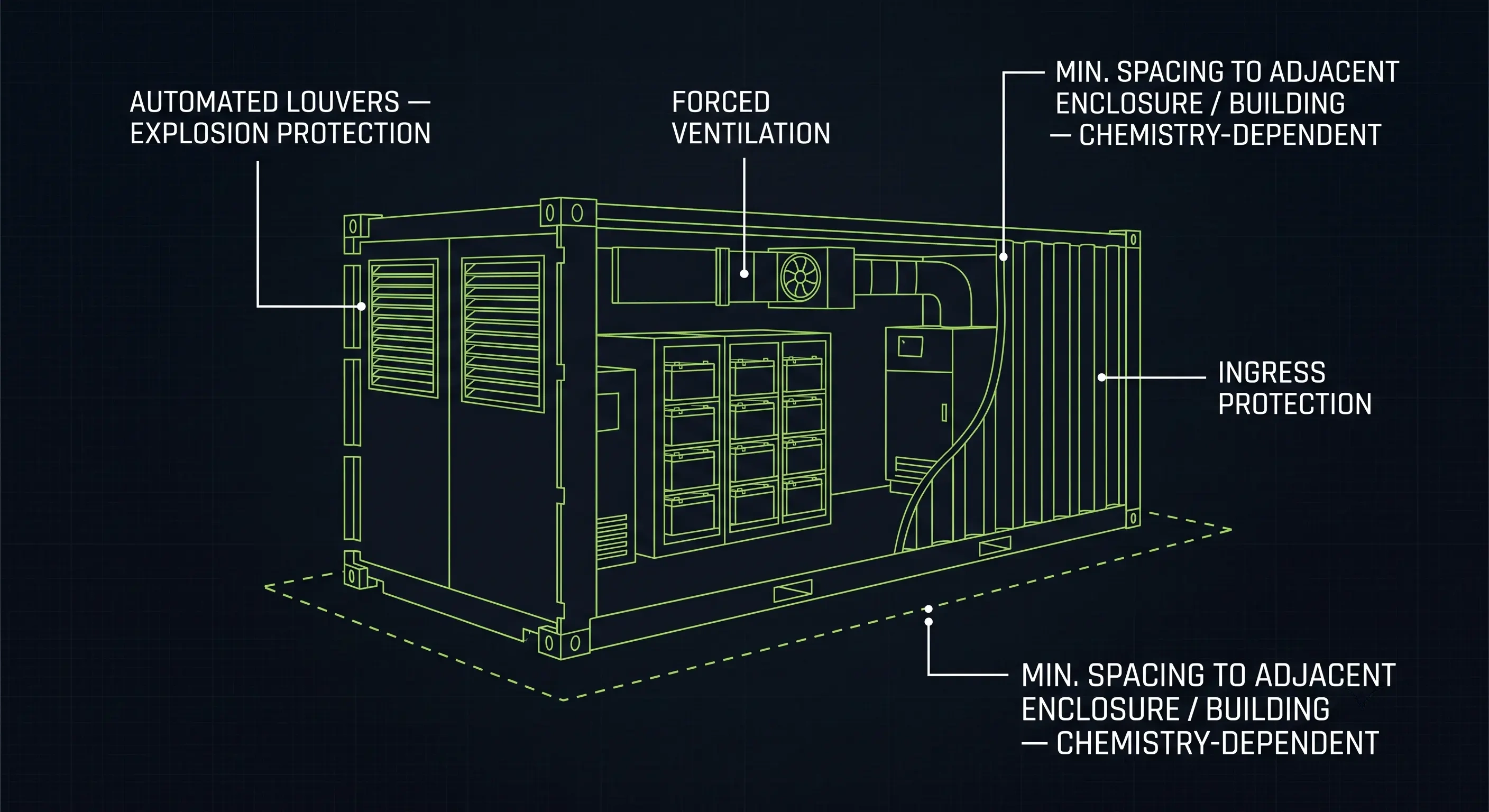
The BESS container must have explosion protection, with a forced ventilation system and automated louvers for safe release of flammable gases and to keep internal pressure within safe limits (Reg. 122(C)(1)). Ingress protection follows the relevant standard (Reg. 122(C)(2)), and where a walk-in unit is used, its entrances and exits must also meet the relevant standard (Reg. 122(C)(3)).
Siting is chemistry-dependent: Regulation 122(D) requires a minimum space separation between adjacent BESS enclosures — and between the BESS and the nearest building — that varies for different battery chemistries, naming Lithium-ion, Nickel-Cadmium, and Lead-Acid explicitly, per the relevant standard.
Ventilation gets its own clause: HVAC and cooling systems must be installed for proper thermal management per relevant standards (Reg. 122(E)(1)), and a mechanism must limit the concentration of flammable materials inside the enclosure (Reg. 122(E)(2)) — with a proviso that if the mechanical ventilation system fails, the BESS shall initiate a shutdown to keep that concentration within safe limits.
Detection, Suppression, and the Fire Safety Audit
The one compliance action with a hard three-month clock
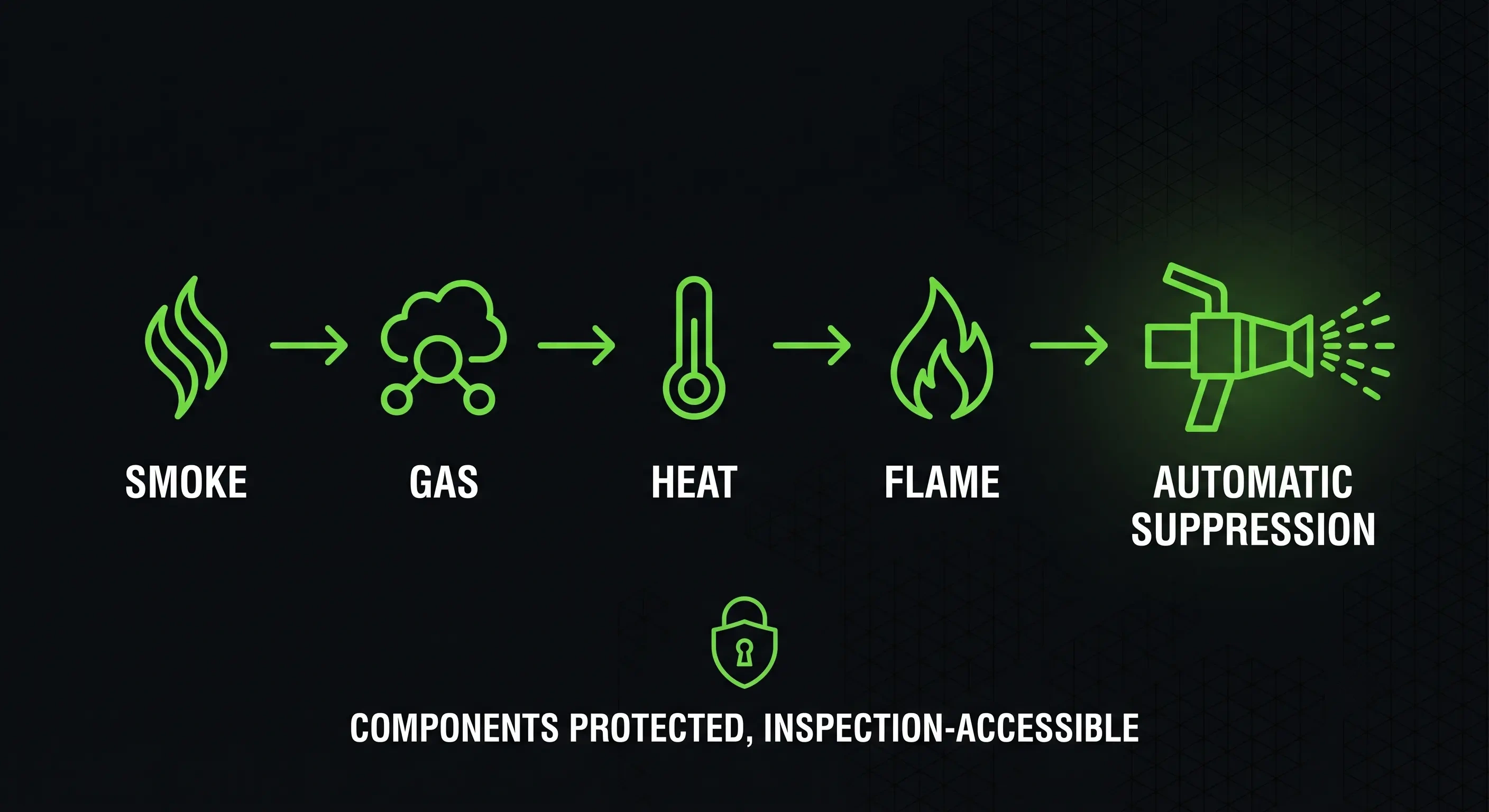
Every BESS container must carry hazard detection for smoke, gas, heat, and flame, monitored per the relevant standard (Reg. 122(F)(1)), plus automatic fire suppression (Reg. 122(F)(2)). The suppression system's own components must be protected from ambient conditions and unauthorised access, while staying accessible for inspection and maintenance (Reg. 122(F)(3)). Batteries with liquid acidic or basic aqueous electrolytes carry a separate spill-containment requirement (Reg. 122(G)).
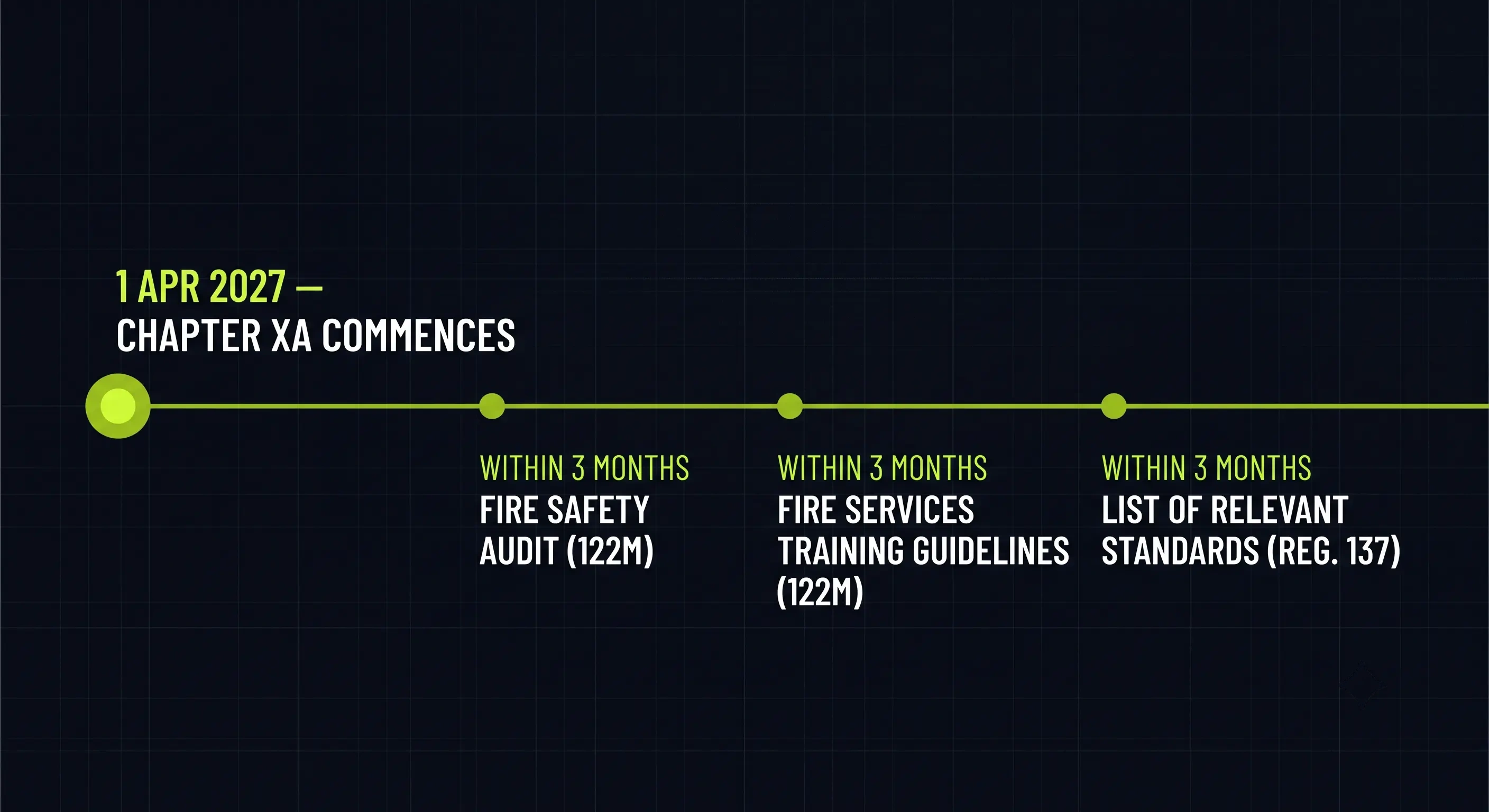
The compliance action with the clearest deadline: an independent third-party fire safety audit is required within three months of the Regulations' commencement, per a Standard Operating Procedure the Authority is yet to issue (Reg. 122(M)(1)). The BESS owner must produce that audit report to the Electrical Inspector — the regulation ties this to "the time of inspection" (Reg. 122(M)(2)), not to a fixed calendar submission date, so only the audit's completion window is fixed, not when it must be handed over.
A parallel training obligation runs on the same clock: the "Appropriate Government" must ensure fire safety officials are trained on BESS-specific risks, and the Directorate General Fire Services must issue training guidelines within three months of commencement (Reg. 122(M)(3) and its proviso).
- 1 April 2027 — Chapter XA commences (Reg. 1(2)).
- Within 3 months — independent third-party fire safety audit conducted (Reg. 122(M)(1)).
- Within 3 months — DG Fire Services issues BESS-specific training guidelines (Reg. 122(M)(3) proviso).
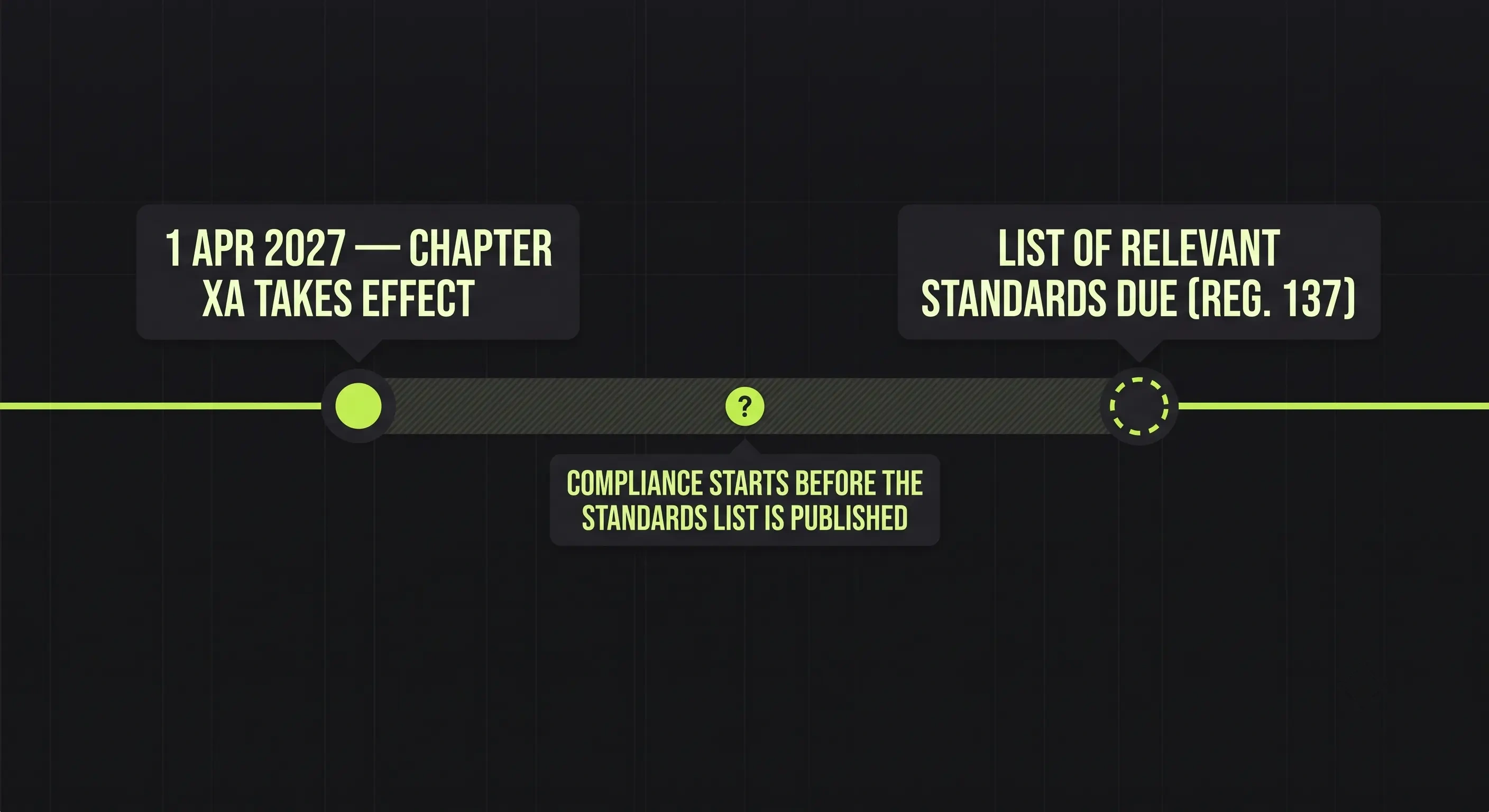
- Within 3 months — CEA publishes the List of Relevant Standards (Reg. 137).
PWRNXT can help a C&I facility evaluate whether a planned or existing BESS design already clears Chapter XA's engineering bar — before the compliance clock starts running.
Free analysis · No obligation
Reply within 4 business hours
Physical Security, Emergency Stops, Lighting and Earthing
The requirements that show up on a site walk, not just on paper
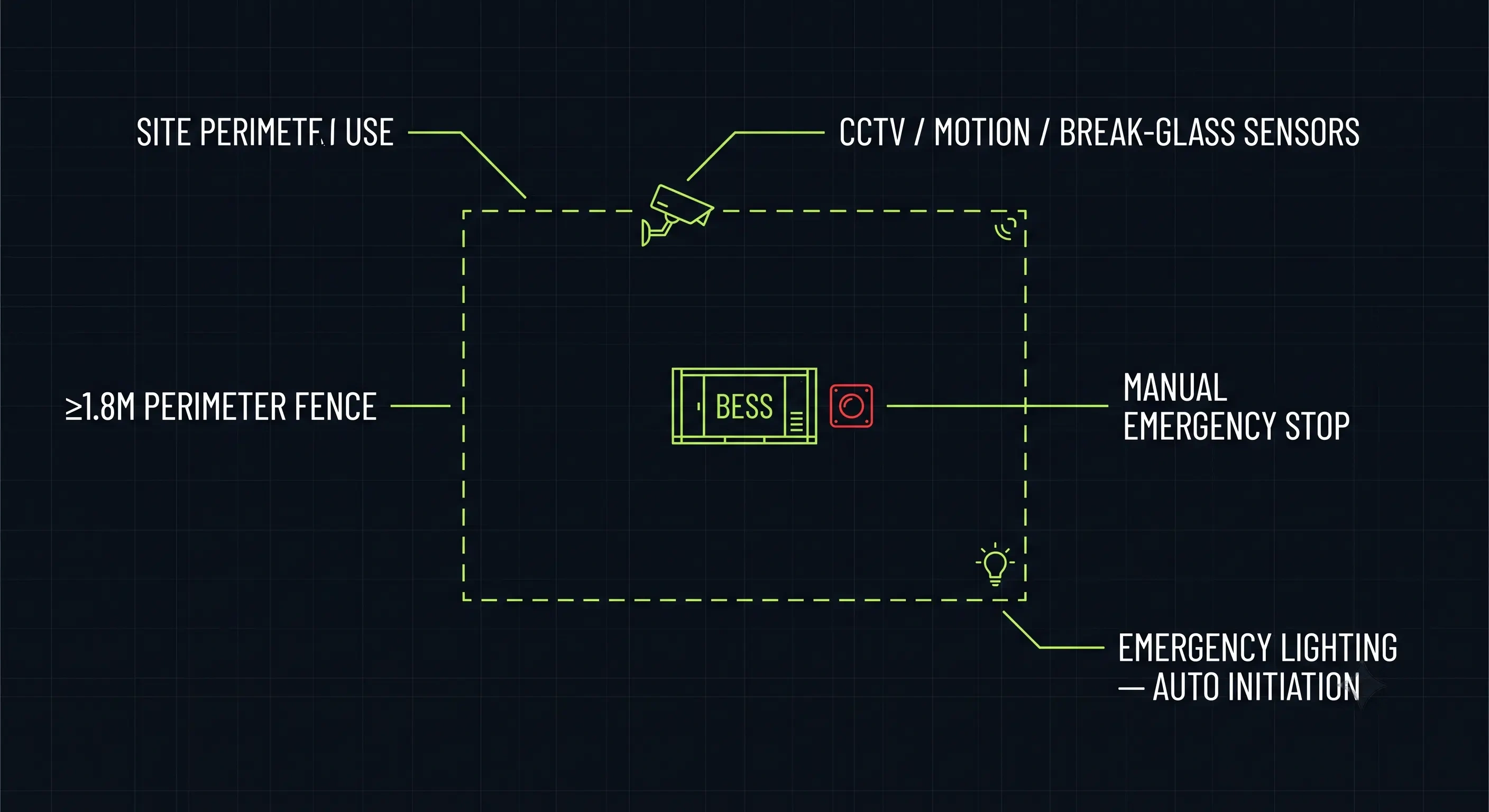
Perimeter fencing must be not less than 1.8 metres high to prevent unauthorised entry (Reg. 122(I)(1)), paired with CCTV, motion or break-glass sensors, and alarms connected to a monitoring-and-response system at appropriate locations (Reg. 122(I)(2)).
On detecting a safety issue or battery anomaly, the affected section must shut down automatically within a pre-set period per the OEM's specification (Reg. 122(J)(1)), and manual emergency stop buttons or switches must be placed at easily accessible, visible locations (Reg. 122(J)(2)). Enclosed working spaces need a separate emergency lighting source with automatic initiation (Reg. 122(H)(1)), with lighting and signage located to support safe access and navigation to the site (Reg. 122(H)(2)). Equipment earthing follows the relevant standard (Reg. 122(K)).
The Missing Piece: "Relevant Standard" Is Not Yet Defined
The compliance target that arrives after the compliance clock starts
Nearly every sub-regulation in Chapter XA conditions compliance on a "relevant standard" — for ingress protection, siting, ventilation, detection, earthing, and more. That list does not yet exist in published form. New Regulation 137 requires the Authority to issue a List of Relevant Standards within three months of the commencement of these Regulations — meaning the list itself is expected only after 1 April 2027, the same date Chapter XA's obligations start running.
What This Means for Anyone Buying, Building, or Leasing a BESS
The regulation names an "owner" — it doesn't say who that is in every deal structure
Regulation 122(M)(2) puts the fire safety audit's submission duty on the "battery energy storage systems owner." The Gazette notification does not address leasing, operating-lease, or as-a-service structures anywhere — it uses the single word "owner" throughout, without resolving how that term applies when the entity operating a BESS isn't the entity that financed it. That means the practical answer depends entirely on how a specific commercial agreement allocates the term, not on anything Chapter XA itself decides.
For any C&I buyer — whether purchasing outright or considering a lease — the same due-diligence question follows directly from the text: confirm in the contract, in writing, which party is designated "owner" for the purposes of Regulation 122(M), since the regulation leaves this open rather than assigning it by default.
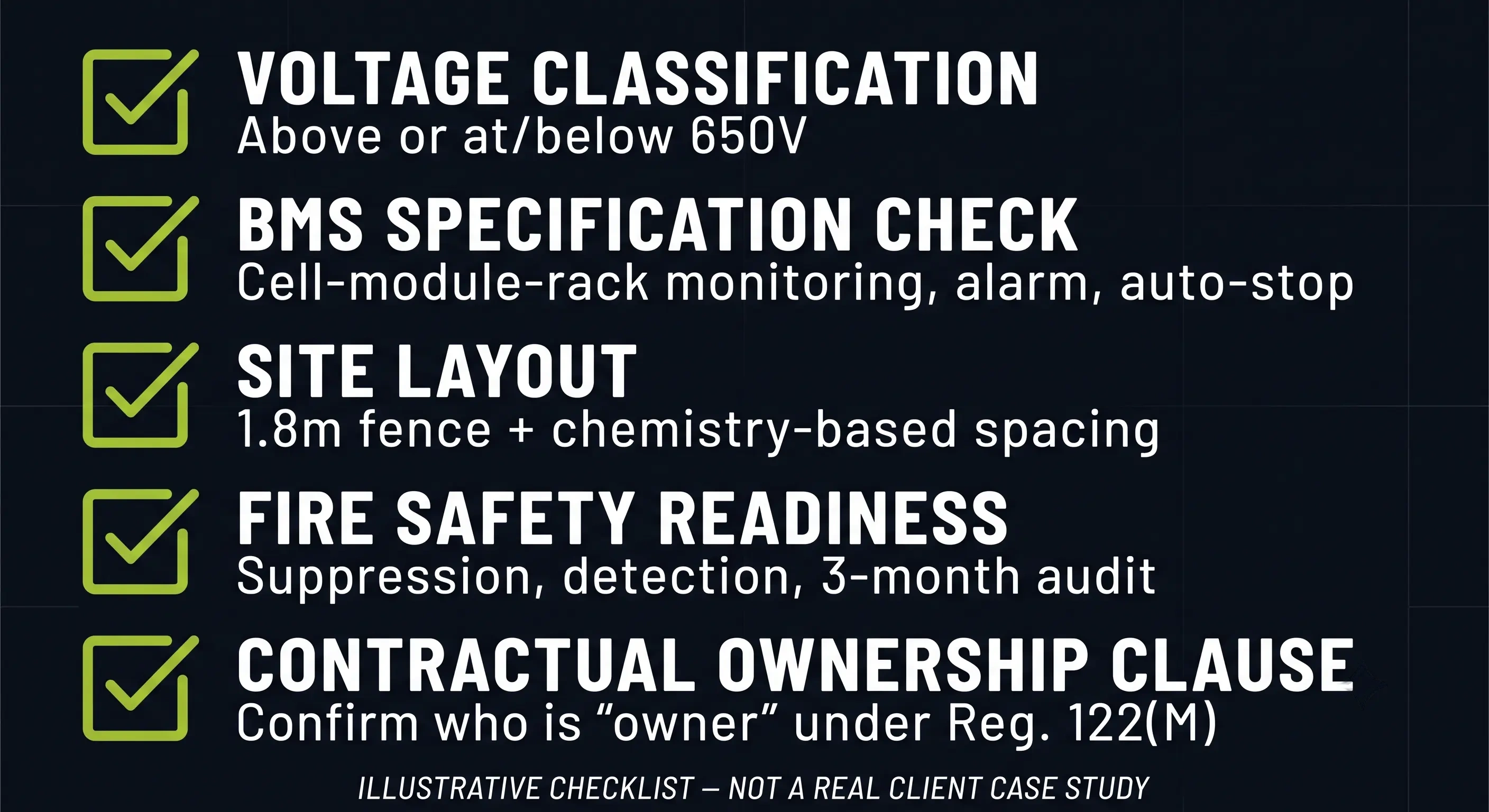
Illustrative figures only: a hypothetical 1 MWh C&I site could use this article's citations as a pre-purchase or pre-lease diligence checklist — checking fencing height, BMS alarm thresholds, and audit timelines against Chapter XA regardless of procurement route. No real client is referenced.
Executive Action Checklist
Five things to verify before signing anything
- Voltage classification — confirm whether the planned connection is above or at/below 650V; that alone decides whether full Chapter XA (122(A)–122(M)) or the lighter 122(N) applies.
- BMS specification check — confirm the vendor's BMS monitors voltage/temperature/thermal runaway at cell-module-rack level and current at rack level, with the two mandated provisos: alarm on limit breach, and automatic charge/discharge stop (Reg. 122(B)(5)(a)).
- Site layout — confirm the site plan can accommodate the ≥1.8m perimeter fence (Reg. 122(I)(1)) and the chemistry-dependent spacing from adjacent enclosures and buildings (Reg. 122(D)).
- Fire safety readiness — confirm the container design includes automatic fire suppression and hazard detection (Reg. 122(F)), and plan for the third-party audit due within three months of commencement (Reg. 122(M)(1)).
- Contractual ownership clause — confirm in writing which party is designated "owner" for the purposes of Regulation 122(M)'s audit-submission duty, since the regulation itself doesn't resolve this for any specific deal structure (see Section 09).
Whether you buy or lease, ask your BESS supplier whether their design already clears Chapter XA's engineering bar — before you sign anything.
Free · 5 working days · No capex commitment
Frequently Asked Questions
The same ten questions from the TL;DR above, in the same order, with the full clause citation for each.
Chapter XA turns BESS safety from an engineering judgment call into a citable checklist — which is good news for any buyer, because it gives a concrete list of clauses to hold a supplier to, months before the compliance clock even starts. The open question isn't whether the rules are reasonable; it's whether a given design can already show its work against each one.
Get a Free BESS Feasibility Study
PWRNXT engineers a free BESS feasibility study for your facility — sized to your load profile, tariff category, and solar capacity, and reviewed against Chapter XA's engineering requirements. Verified findings in 5 business days. Zero cost, zero obligation.