The Legality of Behind-The-Meter (BTM) BESS
Not a defined term — but a fully governed category
Neither draft regulation uses the term "Behind-the-Meter." That gap has led some developers to assume consumer-side storage sits in a grey zone. It doesn't.
Under the Draft GERC (DRES) Regulations, 2026, Clause 2.1(11) defines a Distributed Renewable Energy Source (DRES) as a renewable energy system "with or without BESS" — storage is written into the base definition of a distributed project, not treated as an add-on requiring separate legal cover. Clause 11.4 goes further, listing "BESS, if any" explicitly among the auxiliary systems permitted at a prosumer's premises.
The Draft GERC (BESS) Regulations, 2026 confirms this from the storage side. Under Clause 21.1, consumers and prosumers operating under Net Metering, Gross Metering, Net Billing, Group Net Metering, or Virtual Net Metering arrangements shall be allowed to install BESS at their premises — as a standalone system or paired with renewable generation.
The legal position for C&I developers: consumer-premises BESS is not merely tolerated, it's a defined and regulated category. Treat it as a permitted asset class with paperwork, not an ambiguity to structure around.
The "50% Rule": Mandatory BESS Sizing Explained
The clause that decides whether — and how much — storage you need
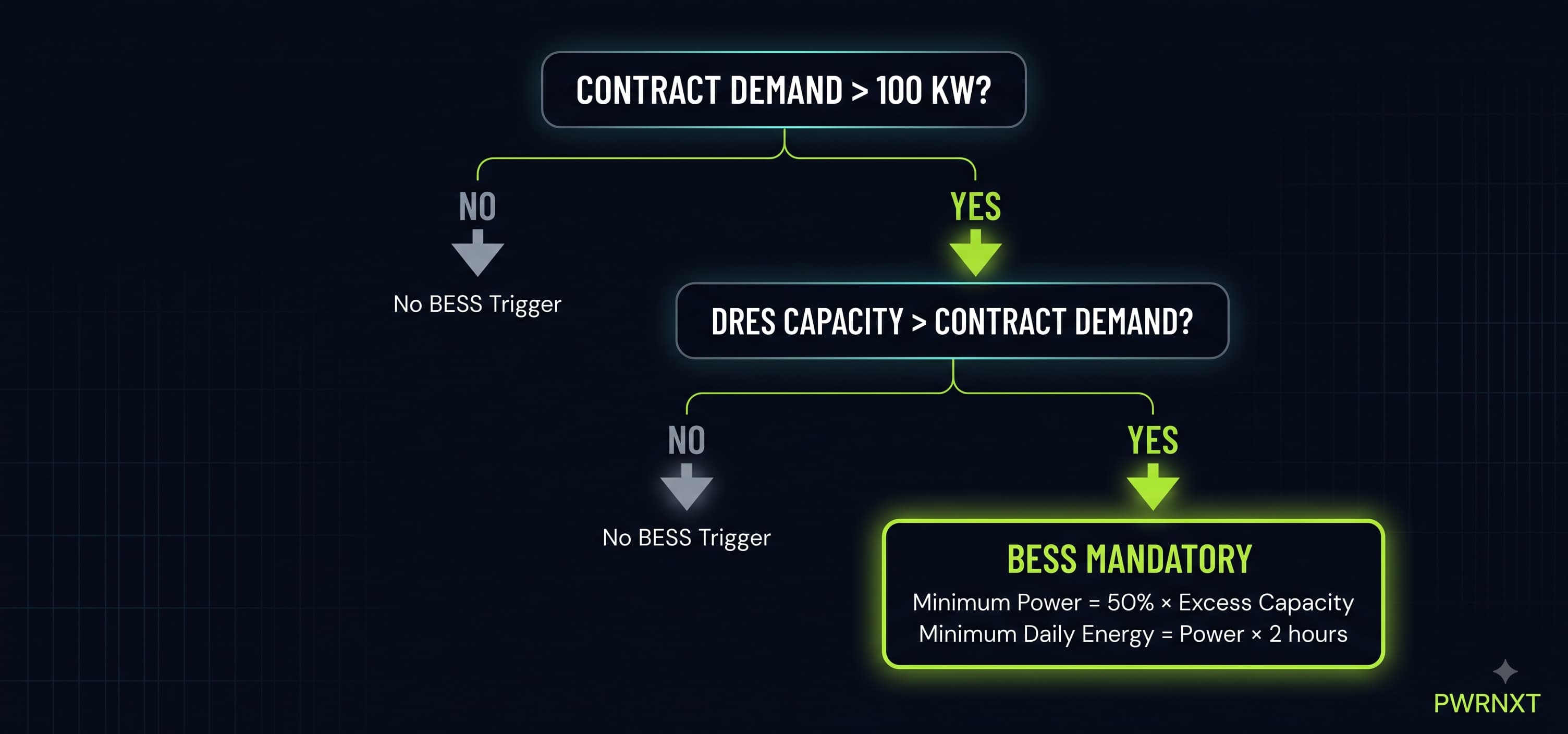
The trigger (Clause 4.9, 8.2, 8.3, 8.5): BESS becomes mandatory ("shall install") when two conditions are both true — Contract Demand exceeds 100 kW, and proposed DRES capacity exceeds that Contract Demand.
The sizing formula: once triggered, BESS must cover at least 50% of the DRES capacity that exceeds Contract Demand, and support at least 2 hours of charge/discharge cycling per day for that excess portion.
BESS Minimum Daily Energy (kWh) = BESS Power (kW) × 2 hours
A separate trigger applies to Virtual Net Metering: under Clause 8.6 and Annexure-V Clause 1.5, BESS becomes mandatory whenever DRES capacity exceeds the aggregate Contract Demand of all participating VNM consumers — with an explicit exemption for residential-category consumers.
ℹ Note: the drafts specify no separate minimum or maximum capacity limit for the BESS unit itself — sizing is governed purely by the 50%-of-excess formula above.
Worked Case Study: 400 kW Solar, 450 kW Contract Demand
Illustrative figures only.
A C&I consumer has an existing 450 kW Contract Demand and a 400 kW solar installation. What are the expansion paths, and where does BESS kick in?
Option A — Expand solar up to 450 kW (Total ≤ Contract Demand): up to 50 kW of additional solar is permitted. BESS trigger: No. Total solar capacity (450 kW) does not exceed Contract Demand.
Option B — Expand solar beyond 450 kW, up to 1000 kW (under NM, NB, or GNM): up to 600 kW of additional solar is permitted, subject to the 1 MW grid-connectivity cap on NM/NB/GNM. BESS trigger: Yes, mandatory.
Taking the full expansion to 1000 kW total DRES capacity:
| Step | Calculation | Result |
|---|---|---|
| DRES excess capacity | 1000 kW − 450 kW | 550 kW |
| Minimum BESS power rating | 550 kW × 50% | 275 kW |
| Minimum daily discharge energy | 275 kW × 2 hours | 550 kWh |
ℹ Source: Clause 4.9, 8.2, 8.3, 8.5, Draft GERC (DRES) Regulations, 2026. Illustrative worked example — figures apply only to the hypothetical 400 kW → 1000 kW solar expansion scenario above.
If this expansion routes through Group Net Metering, the consumer will also carry wheeling charges, wheeling losses, and banking charges under the GERC Green Energy Open Access Regulations, 2024 — a cost layer worth modeling alongside the BESS capex.
Option C — Expand solar up to 4000 kW (under VNM or Gross Metering): beyond the 1 MW cap, further expansion requires Virtual Net Metering or Gross Metering, both capped at 4 MW. Under VNM up to 4 MW, BESS remains mandatory for any DRES capacity exceeding the aggregate Contract Demand of all participating consumers, at 50% of that excess. See Section 04 for the Gross Metering exemption.
PWRNXT models your Contract Demand, metering mechanism, and expansion plan against the 50% Rule before you commit capex.
Free analysis · No obligation
Reply within 4 business hours
The 1 MW Exemption Advantage
Utility-scale minimums don't apply to distributed prosumers
The Draft GERC (BESS) Regulations, 2026 sets a baseline for grid-connected storage in Chapter 2: any standalone, utility-scale BESS project must be at least 1 MW in power rating, carry at least a 2-hour energy rating, and connect at 11 kV or above (Clause 7.2).
That baseline does not apply to consumer-side installations. Clause 7.2 carves out an explicit exemption: this minimum sizing and voltage threshold does not apply to BESS installed under Net Metering, Gross Metering, Net Billing, Group Net Metering, or Virtual Net Metering arrangements by consumers or prosumers.
Navigating Metering Mechanisms
Five arrangements, five capacity bands, five different BESS obligations
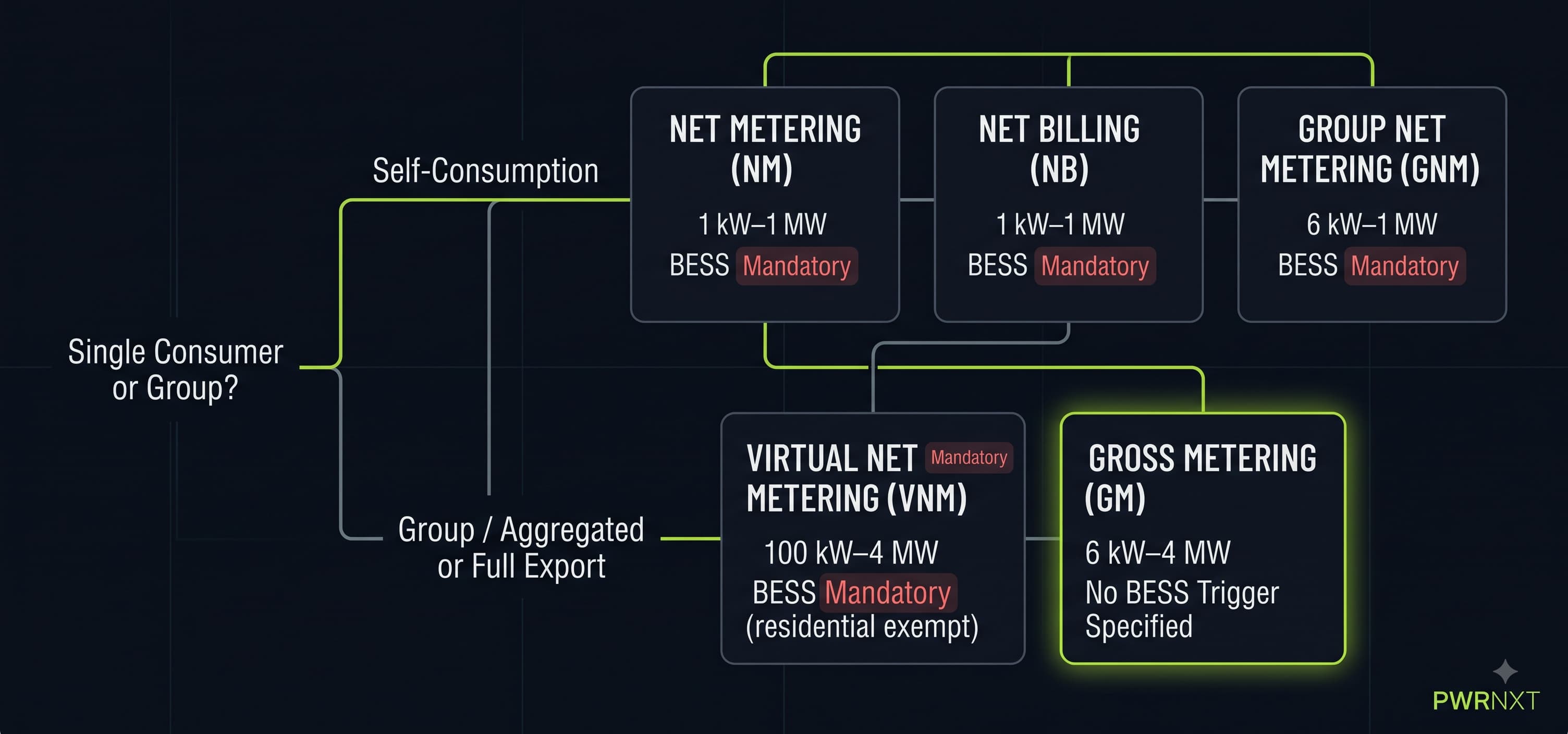
Gujarat's DRES draft routes every project through one of five metering arrangements, each with its own capacity band and BESS trigger status.
| Metering Arrangement | Min Capacity | Max Capacity | BESS Trigger (CD > 100 kW & DRES > CD) | Clause |
|---|---|---|---|---|
| Net Metering (NM) | 1 kW (AC) | 1000 kW / 1 MW (AC) | Mandatory | Clause 8.2 (p.18) |
| Net Billing (NB) | 1 kW (AC) | 1000 kW / 1 MW (AC) | Mandatory | Clause 8.3 (p.19) |
| Group Net Metering (GNM) | 6 kW (AC) | 1000 kW / 1 MW (AC) | Mandatory | Clause 8.5 (p.19) |
| Virtual Net Metering (VNM) | 100 kW (AC) | 4000 kW / 4 MW (AC) | Mandatory (residential exempted) | Clause 8.6 (p.20) |
| Gross Metering (GM) | 6 kW (AC) | 4000 kW / 4 MW (AC) | No BESS trigger specified | Clause 8.4 (p.19) |
ℹ Source: Draft GERC (DRES) Regulations, 2026, Clauses 8.2–8.6.
Group captive structuring (GNM/VNM)
GNM: participating connections must share the exact same name, belong to the same tariff category, and sit within a single Discom's supply area. Capacity band: 6 kW–1 MW.
VNM: participating consumers must belong to the same tariff category and the same Discom. Capacity band: 100 kW–4 MW. VNM projects must connect at 11 kV or 22 kV, with the delivery point at a 66 kV GETCO sub-station via a dedicated evacuation line built at the DRES owner's cost.
Captive compliance: to claim exemption from Cross-Subsidy Surcharge (CSS) and Additional Surcharge (AS), participating connections must strictly satisfy the captive generating plant and captive user criteria under the Electricity Rules, 2005. Fall out of captive status, and CSS/AS apply.
The commercial insight worth underlining: Clause 4.9 explicitly triggers BESS for Net Metering, Net Billing, and Group Net Metering, but it notably omits Gross Metering from the mandatory BESS trigger. A consumer installing 4 MW under Gross Metering to sell 100% of output to the Discom is, per the text as drafted, not mandated to install BESS — a significant capex saving versus the NM/NB/GNM route.
Safety, Approvals, and Back-Feeding Risks
A multi-agency approval chain, and liability that sits with the prosumer
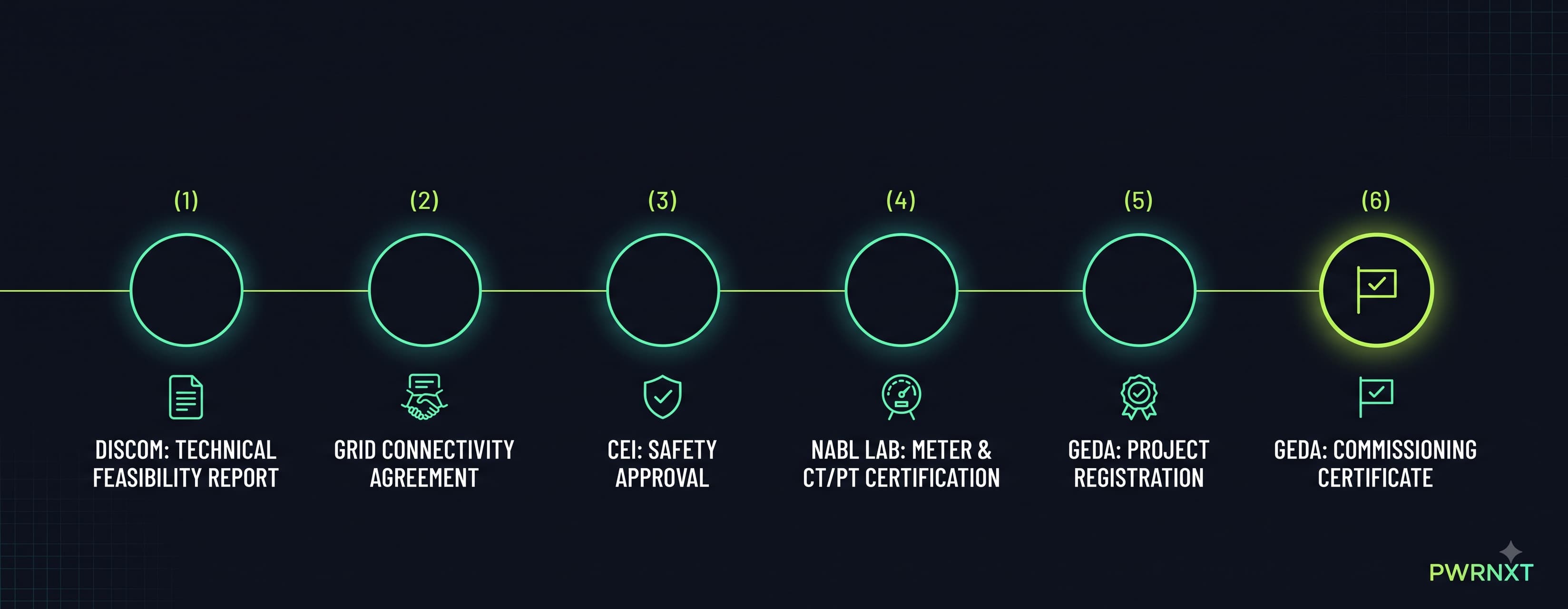
Commissioning a DRES/BESS project in Gujarat runs through a defined, multi-agency approval sequence — miss a step and commissioning stalls.
- Discom: apply for a Technical Feasibility Report (TFR) under Clause 6.1 / Activity 4. On TFR approval, execute a Grid Connectivity Agreement under Activity 7.
- Chief Electrical Inspector (CEI): secure mandatory electrical safety and installation-charging approval under Activity 11 and Annexure-III Clause 3.2.
- NABL-accredited laboratory: obtain testing and calibration certificates for CT/PT units and meters, also under Activity 11 and Annexure-III Clause 3.2.
- GEDA: secure project registration under Clause 8.1(II)(c), and a final Commissioning Certificate under Activity 15 and Annexure-III Clause 3.2.
- Post-commissioning changes: any change to "BESS configuration" after commissioning requires prior intimation and approval from both the Discom and the Commission (Annexure-III Clause 13.1).
Back-feeding: the risk BESS specifically amplifies
Back-feeding is the reverse flow of electricity from a DRES or BESS into the utility network while the grid is de-energized or under maintenance — a serious hazard for line crews and the public. Because BESS is a bi-directional source capable of autonomous discharge, it's flagged as a primary back-feeding risk factor, and Clause 11.7 places sole liability on the prosumer for any fatal or non-fatal accident to humans or animals resulting from it.
Mandatory protections: automatic anti-islanding protection (Clause 11.13) to sense grid failure and disconnect the RE/BESS system immediately; islanding-prevention testing for grid-tied inverters conforming strictly to the IEC-62116 standard; and a manually operated isolating switch between the DRES/BESS and the grid, allowing visible verification of separation.
Governing framework: Clause 15.7 ties BESS deployment within DRES projects to GERC's applicable storage regulations. Grid connectivity must conform to the CEA (Technical Standard for Connectivity of the Distributed Generation Resources) Regulations, 2013, and installations must satisfy the CEA (Measures relating to Safety and Electric Supply) Regulations, 2023.
Grid-Tied vs. Off-Grid Storage
Where GERC's rules apply — and where they explicitly don't
The DRES Regulations govern "grid interactive distributed renewable energy sources" — by design, that scope excludes systems with no grid interaction at all. The Storage Regulations draw the same line explicitly for consumer BESS.
| Regulatory Parameter | Grid-Interactive Consumer BESS [21.1, 21.2] | Completely Isolated / Off-Grid BESS [21.3] |
|---|---|---|
| Applicability of GERC Rules | Full compliance required — must align with grid-interactive scheduling, safety, and accounting procedures [3.1, 12.1] | Exempted from GERC's BESS operational rules |
| Prior Utility Approval | Mandatory — prior approval from Discom/STU required [21.1] | Exempted — no prior approval required |
| Utility Inspection & Certification | Mandatory inspection and technical certification before grid synchronization | Exempted from intimation, inspection, or certification requirements |
| GEDA Registration | Mandatory [21.2] | Exempted [21.3] |
ℹ Source: Draft GERC (BESS) Regulations, 2026, Clauses 21.1–21.3.
If your BESS is completely off-grid — non-grid-connected, in absolute electrical isolation from the utility network — the drafts do not specify any regulatory approvals or capacity limits for that category of installation. That's a real gap in the current text, not a green light to assume zero compliance obligations once the regulations are finalized.
If you remain grid-connected but run an offline BESS or back-up system on-site, that system doesn't inherit the off-grid exemptions — Clause 11.10's back-feeding liability (Section 05, above) still applies.
What This Means for Gujarat's C&I Sector
Read together, the Draft DRES Regulations, 2026 and the Draft BESS Regulations, 2026 give Gujarat's C&I consumers a clear, if compliance-heavy, path to behind-the-meter storage. BESS is not a workaround or a grey-area asset — it's a defined category with its own registration, sizing, and liability rules. The 50% mandatory-sizing trigger and the 1 MW exemption cut both ways: they force storage into projects that exceed Contract Demand, while simultaneously freeing distributed, load-matched systems from utility-scale minimums. The Gross Metering pathway, meanwhile, is the one clear lever in the current draft for developers who want to scale toward 4 MW without a mandatory storage line item — worth watching closely as the regulations move from draft to final form.
For developers and prosumers, the sizing math, the metering-mechanism choice, and the approval sequence all need to be modeled together before a single kW of DRES capacity gets ordered — get the mechanism wrong and you either over-provision storage you didn't need or under-provision for a mandate you missed.