Ask a plant manager in Tirupur or Coimbatore what they pay TNPDCL, and you'll get a per-unit number without a second's hesitation — it's practically muscle memory in a state where spinning mills run three shifts to keep pace with export orders. What that number rarely accounts for is the 25% that gets added the moment the clock strikes six, twice a day, or the 5% that comes back overnight, or the fact that Tamil Nadu taxes electricity as a percentage of the bill rather than a flat paise-per-unit charge — a structural quirk that quietly moves with every tariff revision.
The Tamil Nadu industrial electricity tariff sits under the Tamil Nadu Electricity Regulatory Commission (TNERC), applied statewide through a single distribution licensee, TNPDCL (Tamil Nadu Power Distribution Corporation Limited, formerly TANGEDCO). This article works from TNERC's Tariff Order No.6 of 2025, effective 1 July 2025, with a note on where the FY2026-27 provisional subsidy order (27 April 2026) changes the picture.
Three Common Cost Profiles
Same tariff order, three very different bills
Three buyer profiles come up repeatedly among Tamil Nadu C&I consumers modelling their power costs. Each carries a distinct cost or constraint, worked through with figures in Part 2 of this series.

Take a spinning mill in the Tirupur–Coimbatore belt running solar through Group Captive open access. Every unit it pulls over the grid still carries wheeling charges and a start-up/harmonic-compliance load — but because the plant clears the Group Captive test, Cross-Subsidy Surcharge and Additional Surcharge don't touch its bill at all. The catch is banking: surplus has to be squared away within the same calendar month, with none of the annual carry-forward some other states allow.
A hotel or commercial complex on HT III runs into the same 25%/−5% ToD structure as everyone else, but starting from a higher base — ₹9.40/unit against HT I's ₹7.50/unit. That gap alone means the 25% peak surcharge lands harder in rupee terms on a commercial load than an industrial one. Layer on the load shape itself and the mismatch compounds: a hotel's demand is naturally light through the day and heaviest in the evening — dinner service, guest check-ins, banquet and event load, lobby and façade lighting — which pushes a disproportionate share of its consumption straight into the 6–10 pm surcharged block rather than spreading it evenly across the day the way a mill's shift-driven load does. Higher base tariff and a load curve that peaks exactly when the surcharge does — that's two compounding factors on the same bill, not one.
An educational institute on HT I carries a split personality that most tariff coverage misses entirely: daytime classroom and administrative load behaves like a textbook solar match — steady, concentrated in daylight hours, easy to offset with rooftop or open-access generation. Evening and night load is a different problem altogether. Hostel blocks, mess facilities, and recreational or sports-ground lighting run well into the night, and many campuses simply don't trust grid supply for that load — so it runs on a diesel genset instead, pulling in the Self-Generation Tax line (₹0.10/unit) rather than the grid's ToD-adjusted rate. The result is a single connection straddling two entirely different energy economics: a daytime load that solar can genuinely displace, and an evening/night load that's opted out of the grid's peak-pricing problem altogether by paying for diesel instead.
"This Order will come into effect from 01st July 2025. The Tariffs and other Charges determined in this Order will be valid until issue of the next Order."— TNERC Tariff Order No.6 of 2025, Para 1.5.1
A separate Provisional Tariff Subsidy Order No.4 of 2026 (dated 27-04-2026) deals only with GoTN subsidy flows for LT/domestic/agricultural categories and HT Lift Irrigation — it does not revise core HT I–V demand or energy charges. A CPI-linked escalation (capped at 6% per annum, per the FY2022 order's methodology) is due for HT/LT tariffs from 1 July 2026 but had not been separately notified as of this article's publish date. Figures here are drawn from Tariff Order No.6 of 2025 and should be cross-checked against TNPDCL's latest circular where a decision depends on precision.
TNERC HT Tariff Rates & Categories Explained
Five categories, one thing to get right first
Under TNERC's approved tariff schedule, Tamil Nadu C&I connections above 33kV/HT thresholds sit on one of five High Tension (HT) tariff schedules (a sixth, HT V, applies specifically to EV charging stations with its own ToD-slot structure). Each carries its own Demand Charge (billed per kVA of billing demand — the higher of actual recorded maximum demand or 90% of contract demand) and Energy Charge (billed per unit consumed).
| Category | Applies To | Demand Charge (₹/kVA/month) | Energy Charge (₹/kWh) |
|---|---|---|---|
| HT I | Industries, Factories, IT Services | 608 | 7.50 |
| HT IIA | Govt. Edu./Hospital/Railway Traction/Lift Irrigation | 608 | 7.75 |
| HT IIB | Private Edu. Institutions, Segregated Medical Colleges | 608 | 8.25 |
| HT III | Miscellaneous / Commercial | 608 | 9.40 |
| HT IV | Construction / Temporary Supply | 608 | 13.25 |
| HT V | EV Charging Stations (ToD slot-based) | 304 | 6.50 – 9.75 (slot-based) |
ℹ Source: TNERC Tariff Order No.6 of 2025.
Getting the category right isn't academic. Bill a mixed-use facility under HT I when part of its load belongs on HT III, or miss the residential-quarters carve-out under Para 3.1.1.4 of the tariff order, and every downstream number in this article is wrong for that connection — the demand charge, the energy charge, and the base the ToD adjustment is calculated against all flow from this one classification.
PWRNXT's engineers verify your HT classification and load profile against TNERC's schedule as part of every feasibility study — before modelling a single rupee of BESS savings.
Free analysis · No obligation
Reply within 4 business hours
From here, a worked example carries the maths through every layer of charge — built from a real, verified TNPDCL bill, sized to match the kind of facility PWRNXT actually models for clients.
Tamil Nadu HT Bill Breakdown: Worked Examples
A real 700 kVA HT I bill, line by line
Real Bill: A 700 kVA HT I Textile Mill — May 2026
This is a real, verified HT I bill — 700 kVA contract demand, Erode circle, May 2026 — not an illustrative figure. It shows exactly how TNPDCL's billing engine sequences ToD adjustments, taxes, and open-access charges, line by line.
| Line Item | Rate | Consumption / Basis | Amount (₹) |
|---|---|---|---|
| Industrial Consumption (base rate, all units) | ₹7.50/unit | 90,689 units | 6,80,167.50 |
| Peak Hour Consumption (+25% surcharge only) | ₹1.875/unit | 27,464 units (C1+C2) | 51,495.00 |
| Night Hour Consumption (−5% rebate only) | −₹0.375/unit | 28,584 units (C5) | (10,719.00) |
| Commercial Sub-metered Load | ₹10.45/unit | 175 units | 1,828.75 |
| Total Energy Charges | — | — | 7,22,772.25 |
| Demand Charges | ₹608/kVA | 630 kVA billed | 3,83,040.00 |
| Total Demand + Energy Charges | — | — | 11,05,812.25 |
| Meter Rent | — | — | 4,090.00 |
| Cross Subsidy Surcharge | — | — | 0.00 |
| Additional Surcharge | — | — | 0.00 |
| Electricity Tax — 5% ad valorem | 5% | — | 54,525.44 |
| Assessment Amount | — | — | 11,64,428.00 |
| Open Access Adjustment — wheeling & solar purchase, net | — | — | 17,965.66 |
| Net Amount Payable | — | — | 11,82,394.00 |
ℹ Source: Verified TNPDCL HT I bill, 700 kVA, Erode circle, May 2026. Real client bill referenced throughout this article, not an illustrative figure.
- Peak-hour consumption (27,464 units — C1 morning + C2 evening, ~30% of total energy) added ₹51,495 via the 25% ToD surcharge.
- The 5% night rebate on 28,584 C5 units returned ₹10,719 — a partial but real offset.
- Cross Subsidy Surcharge and Additional Surcharge both read ₹0.00 this month — a real bill confirming the Group Captive-style waiver in practice, not just a policy claim.
- A separate ₹17,965.66 "Open Access Adjustment" line shows the mechanics behind that waiver: ₹95,598.46 in Network (wheeling) Charges and a ₹9,192.00 Electricity Tax recovery on self-generation, netted against ₹86,824.80 paid for power purchased from the solar generator. Wheeling cost survives even when CSS and Additional Surcharge don't.
- Electricity Tax (5% ad valorem) at ₹54,525.44, and a Demand Charge of ₹608/kVA, both check out exactly against this bill — confirming the figures used throughout this article against a separate reference document that showed different rates.
Time-of-Day (ToD) Tariff for Tamil Nadu Industrial Consumers
A two-block structure, not three
"All HT consumers except HT-IIA Lift Irrigation, HT-IV and HT-V e-vehicle CS shall be billed at 25% extra for FY 2022-23 to FY 2026-27 on the energy charges for the energy recorded during peak hours. The duration of peak hours shall be morning 6.00 A.M to 10.00 A.M and evening 6.00 P.M to 10.00 P.M."— TNERC Tariff Order No.6 of 2025, Para 3.1.1.9
Time-of-Day pricing isn't unique to Tamil Nadu, but the shape of it is. TNERC runs a two-block system rather than a three-block, midday-rebate structure: a flat 25% surcharge covers both the morning (6–10am) and evening (6–10pm) peak windows, offset by a flat 5% rebate overnight (10pm–5am). There's no separate midday dip — 'normal hours' is simply the base rate, neither rebate nor surcharge — unlike the three-block structure in the Rajasthan industrial electricity tariff guide, which carves out a dedicated midday off-peak slot. The adjustment is automatic for every HT consumer on a ToD-capable meter, applied to the Energy Charge only; the Demand Charge is untouched.
| Bill Slot Code | Time Block | Hours | Adjustment |
|---|---|---|---|
| C1 | Peak (morning) | 6:00 am – 10:00 am | 25% surcharge |
| C2 | Peak (evening) | 6:00 pm – 10:00 pm | 25% surcharge |
| C4 | Normal | 5:00–6:00 am & 10:00 am–6:00 pm | No adjustment |
| C5 | Night / off-peak | 10:00 pm – 5:00 am | 5% rebate |
ℹ Source: TNERC Tariff Order No.6 of 2025, Para 3.1.1.9.
- C1 — Morning Peak (6:00–10:00 am), +25% on the base rate
- C2 — Evening Peak (6:00–10:00 pm), +25% on the base rate
- C4 — Normal Hours (5:00–6:00 am and 10:00 am–6:00 pm), base rate
- C5 — Night Rebate (10:00 pm–5:00 am), −5% on the base rate
C3 exists as a reserved slot code in the billing system but does not currently appear on operative HT I bills — billing runs on C1, C2, C4, and C5 only. If your bill shows a different slot arrangement, treat your own bill as the source of truth over this article and flag it to TNPDCL for clarification.
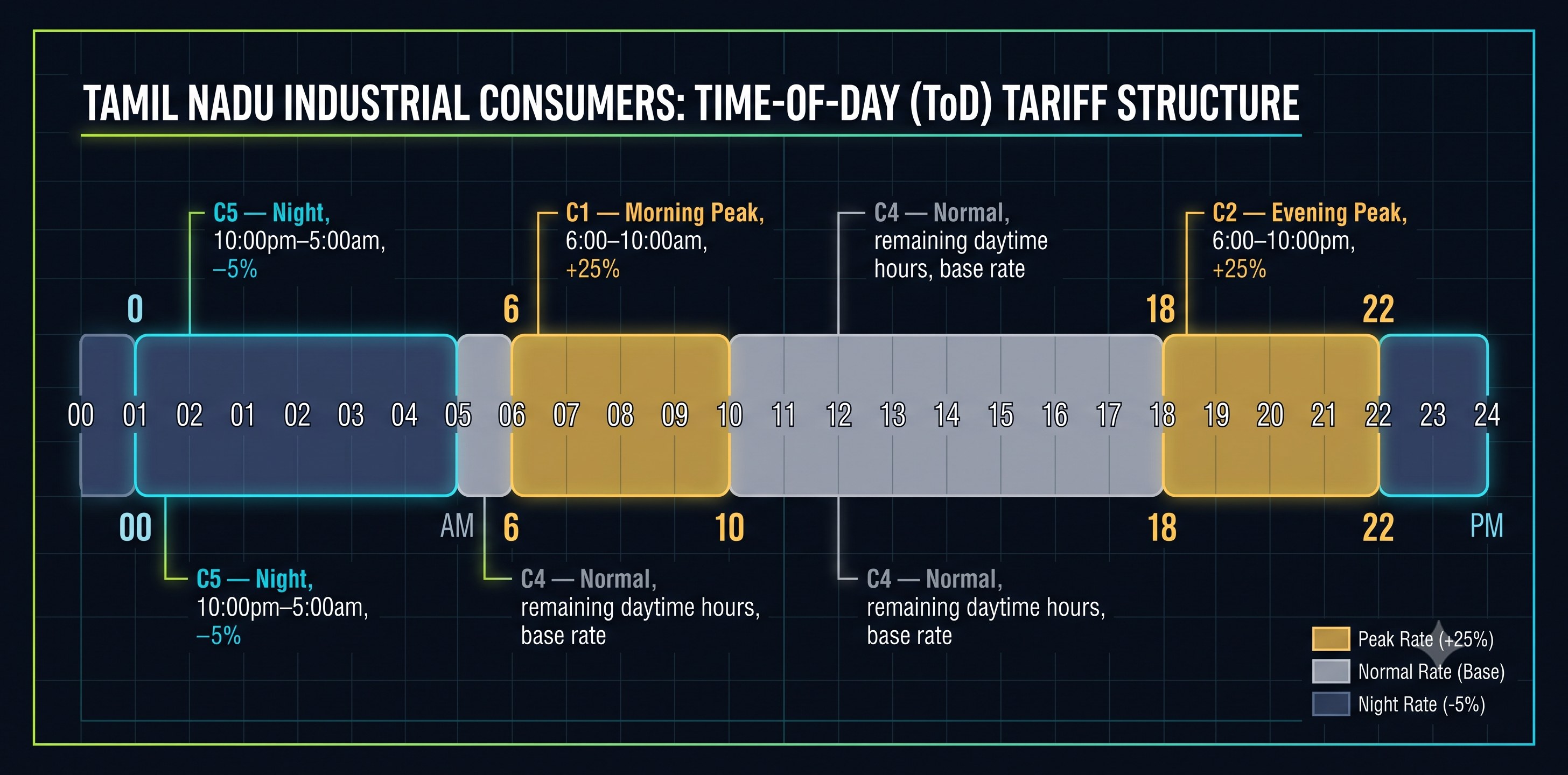
The rate spread this produces is significant. For HT I, the base energy charge of ₹7.50/unit becomes ₹9.38/unit at peak and ₹7.13/unit at night — a 24% swing purely from load timing. For HT III, the spread runs from ₹8.93/unit at night to ₹11.75/unit at peak.
| Category | Normal (₹/kWh) | Peak, +25% (₹/kWh) | Night, −5% (₹/kWh) |
|---|---|---|---|
| HT I (Industries/IT Services) | 7.50 | 9.38 | 7.13 |
| HT III (Commercial/Miscellaneous) | 9.40 | 11.75 | 8.93 |
| LT IIIB (Industries/IT Services)* | 8.25 | 10.31 | 7.84 |
| LT V Commercial (0–100 units) | 6.65 | 8.31 | 6.32 |
| LT V Commercial (above 100 units) | 10.45 | 13.06 | 9.93 |
ℹ Source: TNERC Tariff Order No.6 of 2025. *See LT IIIB footnote below.
Continuing the Real Example: A Textile Mill's ToD Split
The 700 kVA HT I bill above shows this mechanic in practice: of 90,689 total energy units, 27,464 units (30%) fell in the C1/C2 peak slots, adding ₹51,495 at the 25% surcharge rate, while 28,584 units (32%) fell in the C5 night slot, returning ₹10,719 as a 5% rebate. The remaining 34,641 units (38%) were billed at the flat C4 normal rate.
Solar Generation and Tamil Nadu's Evening Peak Window
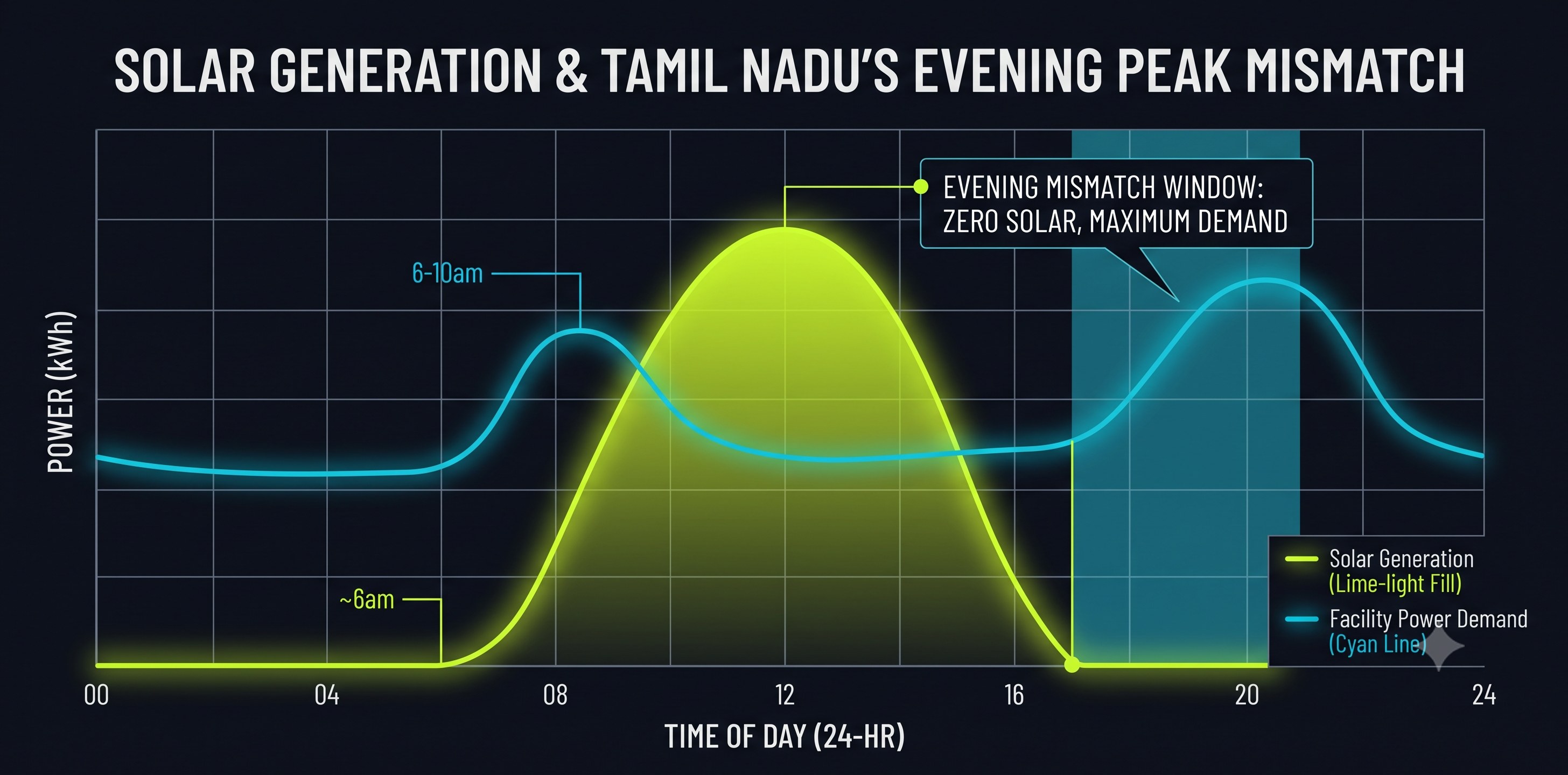
Solar panels don't run at night anywhere, and Tamil Nadu is no exception — by the time the 25% evening surcharge kicks in at 6pm, generation has already tapered to zero. No amount of rooftop or open-access capacity closes that gap on its own, without storage behind it. The morning peak block is a partial exception: arrays are only just ramping up between 6 and 10am, so even morning-peak self-consumption rarely covers the full window without oversizing or storage. Modelling exactly how much storage closes that gap is the subject of Part 2 of this series: How BESS Rewrites the Tamil Nadu Cost Equation.
Tamil Nadu Electricity Tax Rate and Surcharges
A tax that scales with the surcharge, not a flat paise-per-unit charge
Beyond the Demand and Energy Charges, Tamil Nadu C&I bills carry several statutory and regulatory add-ons — and the structure here differs meaningfully from flat-paise-per-unit states.
Electricity Tax in Tamil Nadu is levied at 5% ad valorem — a percentage of the taxable billed amount (energy charges plus peak-hour charges, per the mill bill's own tax-calculation worksheet), not a flat paise-per-unit charge as in several other states. This means the tax scales directly with both the tariff category and any ToD surcharge applied that month — a higher-tariff HT III consumer, or a month with heavier peak-hour consumption, pays proportionally more Electricity Tax, not a fixed amount per unit.
| Charge | Basis | Rate / Example |
|---|---|---|
| Electricity Tax | 5% ad valorem on taxable energy + peak charges | ₹54,525.44 on the mill's ₹10,90,508.85 taxable amount |
| Self-Generation Tax (Diesel Genset) | Flat per unit | ₹0.10/unit |
| Low Power Factor Compensation | % of current consumption charges per 0.01 PF shortfall below 0.90 | 1% (0.90–0.85) / 1.5% (0.85–0.75) / 2% (below 0.75) |
| Harmonics Compensation Charges | Per IEEE 519-2014 non-compliance | As per Supply Code |
ℹ Source: TNERC Tariff Order No.6 of 2025; verified TNPDCL HT I bill, May 2026.
Cross-Subsidy Surcharge (CSS) is a category-specific rate, capped at 20% of the tariff as per the Tariff Policy formula, and applies only to open-access consumers who are not exempt (see the next section):
| Category | CSS (₹/kWh) |
|---|---|
| HT I (Industries) | 1.99 |
| HT IIA (Govt. Educational Institute) | 2.19 |
| HT IIB (Private Educational Institute) | 2.46 |
| HT III / HT V (Miscellaneous / EV Charging) | 2.57 |
| HT IV (Temporary Supply) | 3.50 |
ℹ Source: TNERC Tariff Order No.6 of 2025, Para 2.4.1–2.4.2.
Wheeling / Network Charges:
| Voltage Level | Rate (₹/kWh) |
|---|---|
| HT | 1.04 |
| LT | 1.60 |
ℹ Source: TNERC Tariff Order No.6 of 2025, Para 2.4.1–2.4.2.
Solar Banking & Open Access Tariff Rules in Tamil Nadu
Monthly-only banking, and a settlement order that isn't first-come-cheapest
Under TNERC's Green Energy Open Access Regulations, 2025, Tamil Nadu's banking rules are considerably tighter than states that allow annual carry-forward. Banking is permitted only on a calendar-month billing-cycle basis, with no facility to carry credit into the following month.
| Rule | Detail |
|---|---|
| Banking charge | 8% of energy banked, adjusted in kind |
| Banking cycle | Calendar month; energy accounted on a 15-minute time-block basis |
| Carry-forward | Not permitted — credit for banked energy must be used within the same billing cycle |
| Legacy exception | Wind generators commissioned on or before 31-03-2018: 12-month banking (April–March), 14% in-kind charge |
| Third-party sale | No banking facility at all for third-party power purchase/sale |
| Unutilised month-end surplus | Sold to DISCOM at 75% of applicable RE tariff (or 75% of latest discovered bid tariff where no RE tariff is determined) |
ℹ Source: TNERC Green Energy Open Access Regulations, 2025.
Net Metering / Energy Settlement Priority
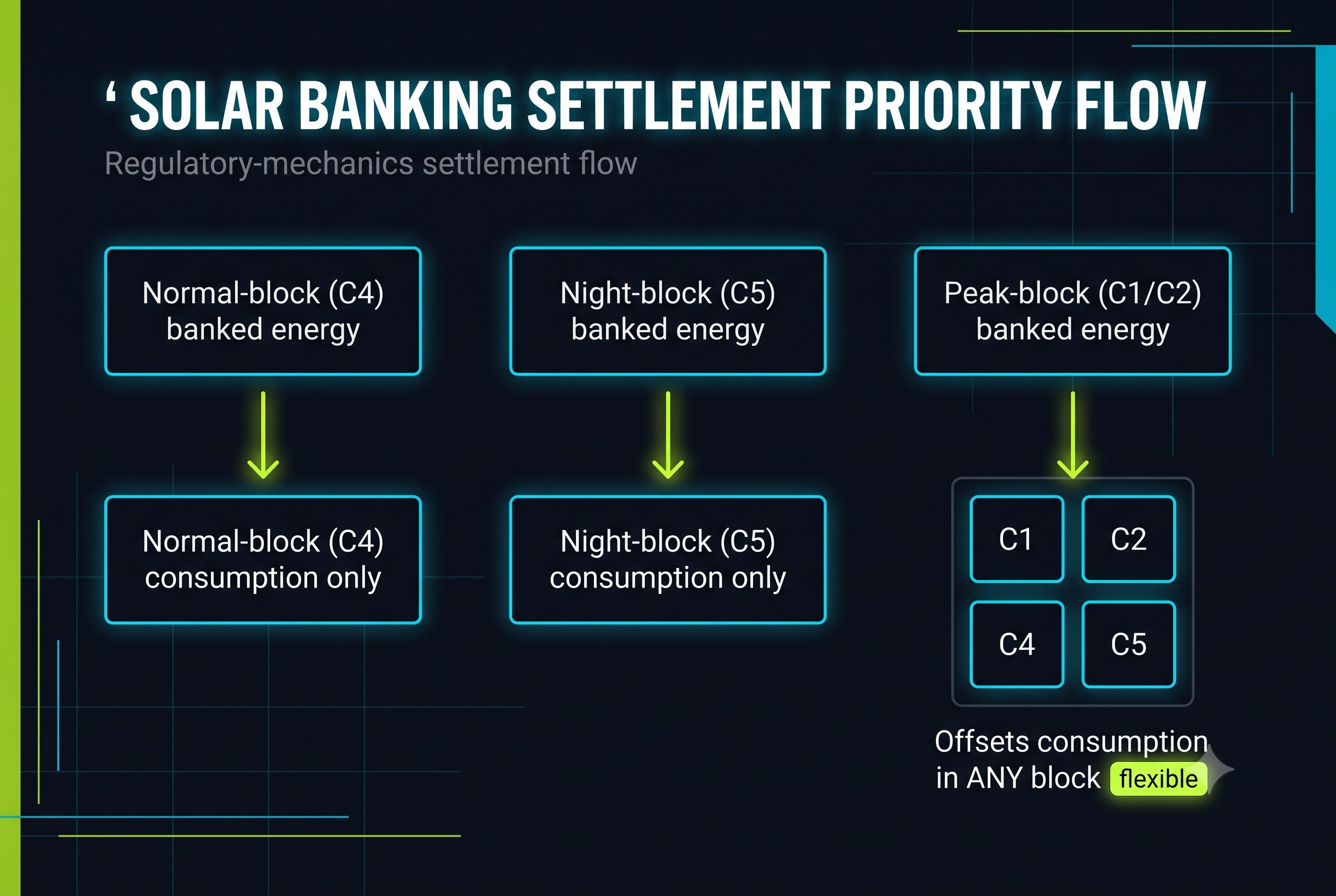
Tamil Nadu's settlement rule under Regulation 13 of the GEOA Regulations, 2025 works differently from states that settle surplus starting from the cheapest tariff slot first. In Tamil Nadu, banked energy generated during the normal-hour block can only be adjusted against normal-hour consumption, and night/off-peak banked energy can only be adjusted against night/off-peak consumption — but banked energy generated during the peak-hour block can be adjusted against consumption in any block. This gives peak-hour solar surplus (a relatively small share of generation, since solar output is weakest at the edges of the morning-peak window) unusual flexibility, while normal- and night-block surplus stays locked to matching consumption blocks.
Open Access: Wheeling, CSS, and Additional Surcharge
This is where most coverage collapses a real distinction into a single 'open access' bucket. Wheeling Charge applies regardless of ownership structure. Cross-Subsidy Surcharge and Additional Surcharge, by contrast, carry a confirmed full waiver for Group Captive consumers — a materially larger concession than a partial exemption, and one that changes the sourcing-structure comparison significantly against third-party (merchant) open access.
| OA Type | Wheeling Charge | Cross-Subsidy Surcharge | Additional Surcharge |
|---|---|---|---|
| Third-party / Merchant OA | Applicable | Applicable | Applicable |
| Group Captive OA | Applicable | WAIVED (confirmed) | WAIVED (confirmed) |
| Green Energy OA — intra-state | Concessional | Per Commission order | Per Commission order |
| Green Energy OA — inter-state / Power Exchange | No concession | No concession | No concession |
ℹ Source: TNERC Green Energy Open Access Regulations, 2025, Regulation 15.
Combined with the tighter, month-only banking window, this shows the real lever for a Tamil Nadu open-access buyer such as the textile mill described earlier: because the plant qualifies as Group Captive, Cross-Subsidy Surcharge and Additional Surcharge don't apply at all — wheeling and the strict monthly banking mechanics are the two remaining open-access-specific frictions on the bill.
Putting It All Together: The Consolidated Bill and Charge Pecking Order
The exact sequence TNPDCL's billing engine uses
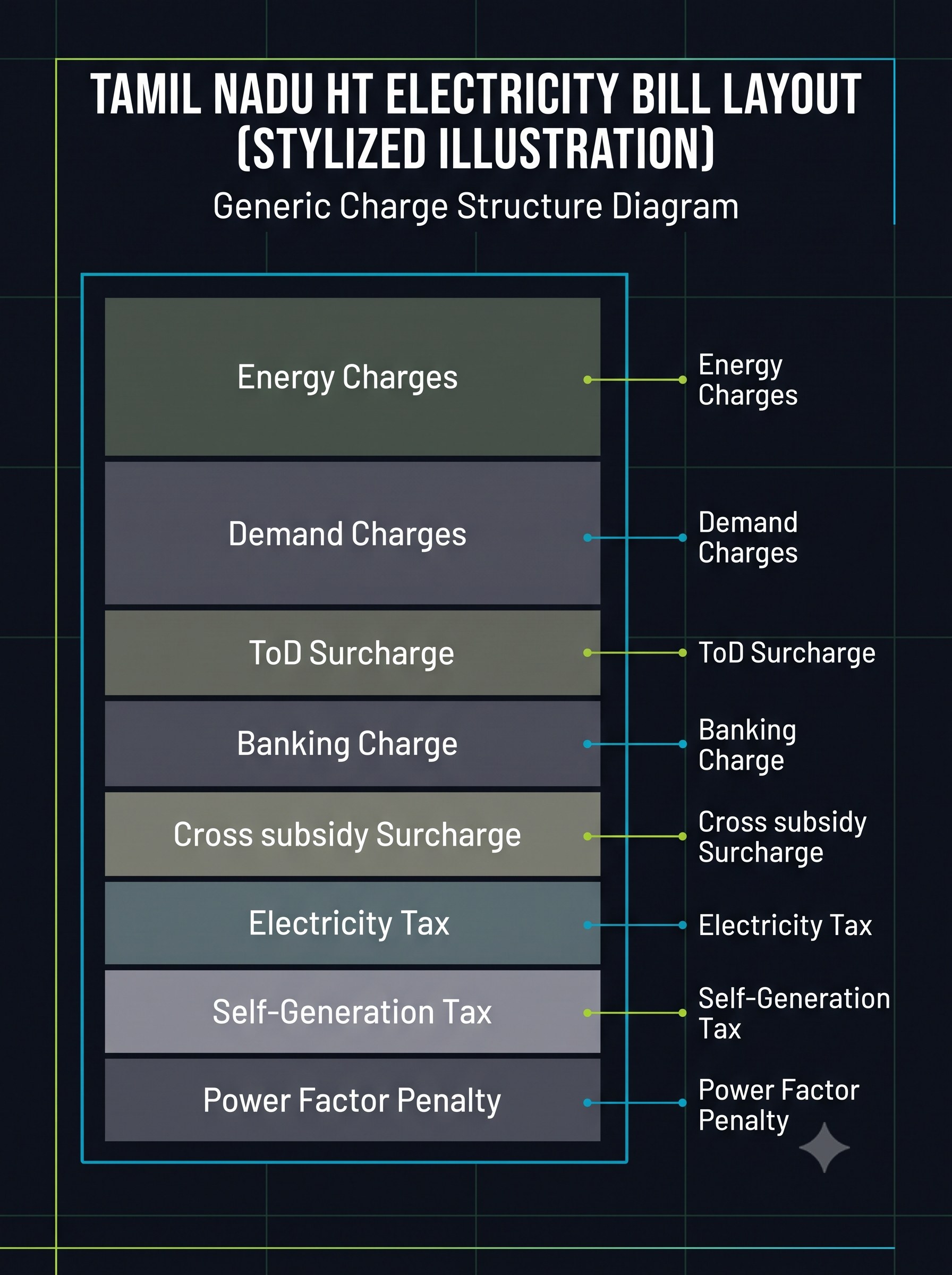
Pulling every line item together in the sequence TNPDCL's own billing engine uses — as shown on the real HT I bill referenced throughout this article — a Tamil Nadu C&I bill stacks up as follows:
| Sequence | Charge | Basis |
|---|---|---|
| 1 | Energy Charges (base + peak/night ToD adjustment) | Normal rate ±25% peak / −5% night by time block |
| 2 | Demand Charges | Billed kVA × category rate (higher of recorded MD or 90% of contract demand) |
| 3 | Meter Rent | Fixed, per service |
| 4 | Cross Subsidy Surcharge (if open access, non-exempt) | Category-specific ₹/kWh, capped at 20% of tariff |
| 5 | Additional Surcharge (if open access, non-captive) | Rate to be confirmed against current TNPDCL circular |
| 6 | Electricity Tax | 5% ad valorem on taxable energy + peak charges |
| 7 | Self-Generation Tax (if captive/DG generator) | Flat per unit, e.g. ₹0.10/unit for diesel genset |
| 8 | Power Factor penalty (if PF below 0.90) | 1–2% of current consumption charges per 0.01 PF shortfall |
ℹ Source: TNERC Tariff Order No.6 of 2025; verified TNPDCL HT I bill, May 2026.
On this real bill, that sequence produced a Net Amount Payable of ₹11,82,394.00 against a Total Demand + Energy Charges base of ₹11,05,812.25 — meaning the statutory and open-access add-ons together contributed roughly 7% on top of the base charge for this particular month, even with both Cross Subsidy Surcharge and Additional Surcharge reading zero.
Conclusion: Where BESS Fits Into the Tamil Nadu C&I Cost Structure
The most expensive unit is the one you draw at 6pm
Strip away the line items and Tamil Nadu's C&I tariff makes one thing clear: the most expensive electricity a facility buys is the electricity it draws from the grid during the C1 and C2 peak slots — 6–10am and 6–10pm. That's not just the 25% ToD surcharge. Because Electricity Tax is ad valorem, not flat, the tax rides on top of that inflated peak base too — so a peak-hour unit costs more in every layer of the bill, not just the energy charge line. For an open-access consumer that isn't Group Captive, CSS and Additional Surcharge compound the same way.
At the same time, Tamil Nadu's own solar rules quietly discount a facility's own generation. Banking works only within the same calendar month, with no carry-forward — and whatever surplus is left unbanked at month-end gets bought back by TNPDCL at just 75% of the applicable RE tariff, roughly ₹2.50/unit on a typical solar tariff. Layer on the settlement-priority rule — normal-block solar can only offset normal-block (C4) consumption, night-block (C5) solar only night-block consumption — and a facility can end up sitting on low-value or effectively lapsed solar most months, simply because its generation curve and its peak-hour draw don't line up on the clock.
That mismatch is exactly the gap a Battery Energy Storage System is built to close. Instead of letting midday solar generation settle at a discounted ~₹2.50/unit buyback or get stranded by a block-locked banking rule, BESS lets a facility store that same low-cost or otherwise-lapsed solar and discharge it precisely into the C1 and C2 peak windows — displacing grid power that, once the ToD surcharge, ad valorem tax, and (for non-captive open access) CSS and Additional Surcharge are all stacked on, typically lands in the ₹10–12/unit range for many HT categories. That spread — roughly ₹2.50/unit sold back versus ₹10–12/unit avoided — is the value BESS is built to capture, and it doesn't need TNERC to resolve the Additional Surcharge ambiguity or notify the FY2026-27 CPI escalation first. The numbers behind exactly how much storage that takes, and what it's worth for a given load profile, are the subject of Part 2 of this series.
PWRNXT sizes a BESS to store your low-cost solar and discharge it straight into Tamil Nadu's C1/C2 peak windows — closing the spread this article just walked through, at zero capex.
Free · 5 working days · No capex commitment
Frequently Asked Questions
Straight answers to the questions Tamil Nadu C&I consumers ask most often about ToD, tariff categories, and solar banking.
Model Your Tamil Nadu C&I Open Access Savings
Every lever in this article — Group Captive structuring, the two-block ToD spread, the monthly banking ceiling — feeds into a single landed-cost number for your facility. Talk to PWRNXT's team to model your Tamil Nadu open access savings, or watch for Part 2 of this series for how battery storage changes the equation: How BESS Rewrites the Tamil Nadu Cost Equation.